pinterest pin it

Showing posts with label flowers. Show all posts

Friday, May 7, 2021

Still Life Dichroic Brooch

Thanks to my Tuesday afternoon Beading Circle for challenging me to create something fresh. Our Zoom meetings are a great opportunity for beady friends to compare notes, share bead trivia, discuss beading technique, spotlight new designers and patterns. Everyone is beading at home with their stashes nearby. Its fun to do bead along projects.

When the idea of doing a beaded brooch in April arose, folks assumed this would be a bead embroidery challenge. Someone suggested to peruse one’s stash for a button or cabochon as the starting point for a brooch focal. I did not have any buttons.

I’d like to share my creative process of my Still Life Dichroic Brooch.

DICHROIC FRAME ART
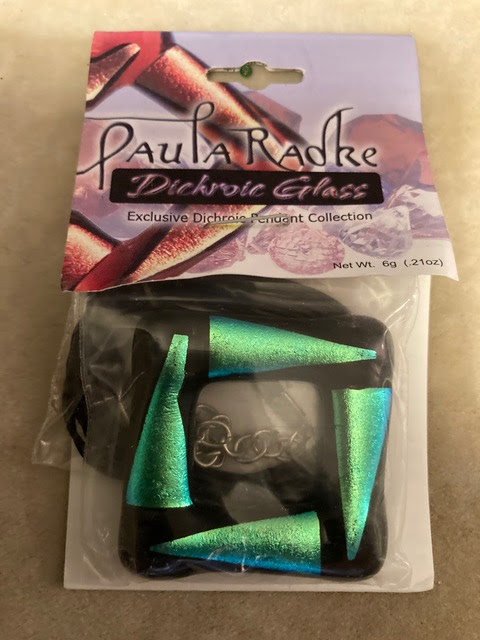
I did have a dichroic lampwork square frame pendant kit by Paula Radke from way back when I was participating in international bead shows in the late 2000s - early 2010s. I never strung the frame to wear, so it was perfect for my brooch!!


I envisioned the dichroic square as a frame for a miniature artwork. Google is full of images of paintings for inspiration! Rainbow Ridge - Colorful Landscape by Julie Brugh Riffey spoke to me. 


I poured a little of every intensely-colored charlotte 11o beads onto a Chinet® plate for painting with beads with the Ndebele technique.


I managed to recreate the feel of Rainbow Ridge one bead at the time. My beaded interpretation is dancing in the frame because of the shadows created by beads sitting at herringbone angles and the charlotte-cut of the beads which reflects light.


STILL LIFE 

Next, I used the leftover unique black-copper bead from the TBS 2021 Bag of Bead Challenge for a vase. Using the daisy stitch I filled the vase with beaded red and scarlet flowers.


To make sense, I decided to create a still life composition with my two main elements. Again, I looked through artwork on the internet for ideas. How do I show surfaces, light and shadows using beads? The artwork needs to be hung on the wall. The vase of flowers needs to be placed on a table.


TILA WALL

While scrounging around my stash I found a few surprises. I forgot I bought four tubes of Miyuki Tila Bead. Also, I purchased an assortment of microscopic seed beads from Bead Cats  in sizes 16o to 24o. I knew I had bugle beads in different sizes for creating the tabletop. 

The flat tile-shaped 2-hole Tila beads were ideal for creating a wall. I played around with square-stitching one tile to another and stringing a wonderful bronze-lined 15o seed bead between stacks of tiles. 


The wall grew tall and wide around the frame. The stepped down tile wall reminds me of Art Deco.
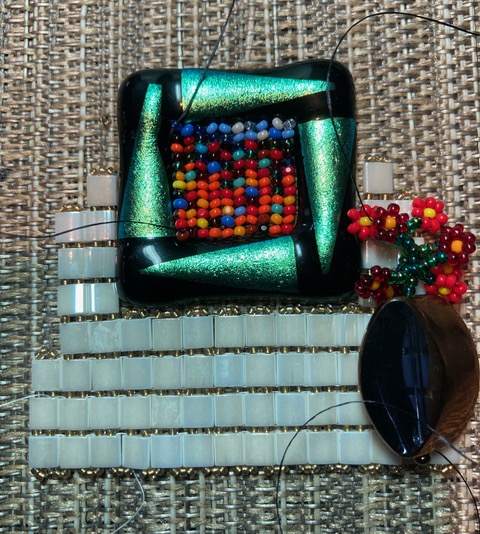
 

I had to work out how to assemble my beadwoven art in the frame, how to stitch my wall down. To create the brooch I needed some foundation to stitch and secure it to. I ordered a stiff felt beading foundation and a faux leather for a backing for my brooch from i-Bead

NETTED FLORAL TRIM 

I wanted my still life tablecloth to have a floral design. This is where the microscopic seed beads can in handy. The top of the netted tablecloth has microfine vintage bugles meeting up at the bronze-lined seed bead.

I found these would be a safe bet to connect the netted trim to the foundation. I sketched out a netted design in colored pencils. Clever color placement made it look like flowers with leaves. 

Each row of this vertical net is finished in a picot trim. The floral pattern was made to the width of the Tila wall.


Now was the time to stitch down the wall to the foundation. I cut out a rectangle of stiff felt, placed the netted tablecloth and calculated how high should the wall be placed.

How much space to I need for my bugle tabletop between the two?

BUGLE TABLE

I marked where to stitch the seed bead for the top of my netted tablecloth. This way everything was perfectly spaced. 

The wall was stitched down along the seed beads between Tilas. I then laid out the different colors of bugles trying to capture the light and depth of a table top.

TIP: To keep the color sequence intact for reference, take clear tape and press down on the bugle layout. The sticky tape will pick up the bugle rows as a single unit. Place it up higher for reference to see which bugle to pick and stitch them permanently in place. 

HANGING THE PICTURE FRAME

Then, it was time to hang up the picture. Luckily, there was a space on the wall for the frame. First, I traced the inside of the frame to know the positioning of the herringbone-stitched picture. I stitched my artwork to the foundations by stitching randomly between the beads.


To secure the frame to the foundation, I used a single continuous line of Aileen’s glue. Then I pressed down the dichroic frame in position on top the glue. 

Once the glue dried, I stitched down the corners of the frame carefully not to break up the dichroic triangles design. I used single strings of fine black beads to stitch down each corner.  Then I reinforced them with extra stitches close to the bead strings. This way the glass frame is securely part of the foundation, an important consideration since I will need to add a brooch pin to wear!


Time to add the vase on the tabletop. The tail below the stop bead at the bottom of the copper vase was handy for securing through the tabletop bugle row. I then had to go up through the vase to secure the odd-shaped copper bead. The remaining thread from the daisy flowers was used to stitch down the flowers in a few places. 


To balance the composition, I created another vase using an incised Indian bead as the vase. Petal beads in my stash came in handy to create an exotic bloom. By stringing a 15o between each petal I was able to create a flower. It is topped with a melon bead with a coral turnaround bead for zing. This vase was positioned on the tabletop and stitched down to the background.

BROOCH PIN

Thanks to Naomi Smith of Black Tulip for sharing her technique of attaching vintage pins to brooches. I borrowed the pin from my Bead Poppy I beaded in her workshop. 


TIP: For a discreet brooch clasp, I centered and stitched across the 1” strip 1/4” down from the top of the faux leather backing. This was to prevent the vintage brooch pin from riding up too high.

BACKING

The brooch needed a backing for a tidy finish. I used faux leather which was really nice to work with. I cut it out in the same shape as the foundation. Also, I cut out a 1” wide x 3-1/4” brooch pin holder strip.

Time to start stitching the backing onto the foundation. For every stitch I added the 15o seed bead. This created a fine smooth discreet bead edge. The 1” strip was stitched together the backing. When I started stitching up near the black frame, I quickly recalled a tip to darken the edge.


TIP: Use a Permanent Sharpie marker to tone down the white foundation edge.
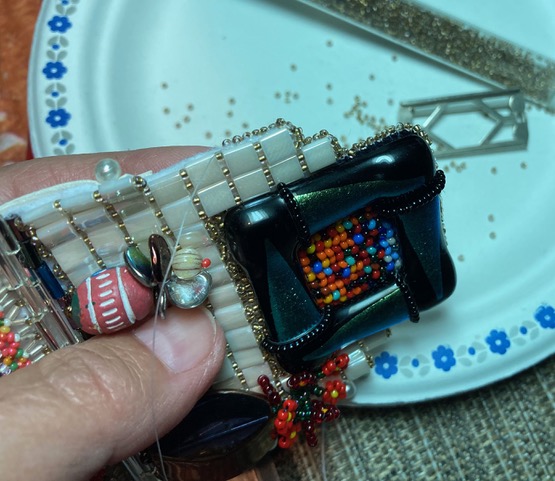

The bead edge-stitching continued down to the bottom and along the lower edge underneath the netted floral. The lower edge of the brooch pin strip was trimmed even to the lower edge and stitched together with the backing. The bead edge continued up to meet the start.

I slipped in the brooch pin under the strip ready to wear. I’m pleased my brooch is balanced and comfortable to wear.


Saturday, August 22, 2020

Sunflower Mask

The Toronto Bead Society’s Mask Challenge for an Aug 12, 2020 Zoom meeting and a request for a “fantasy piece” for an upcoming bead exhibit at the Ukrainian museum converged into this Sunflower Mask!


The Ukrainian Museum of Canada Ontario Branch and our neighbours at the Native Canadian Centre of Toronto are planning a co-produced exhibit titled The Spirit of Beads: Sharing our Stories.

What could be more Ukrainian than sunflowers?? They are Ukraine’s national flower and represent the warmth and power of the sun, which was worshiped by pre-Christian Slavs.

Inspiration photo and bracelet

My husband found this photo of a vibrant rich field of sunflowers. A netted bracelet with a beaded sunflower on top by Ulana Bobyk from Lviv inspired my freeform flowers.

I wanted my sunflowers against a bright blue sky. Jo-Ann gave me the perfect piece of ultra-suede for the background and cotton fabric to match at a time when stores with non-essentials were closed. I was determined the sky should be smooth all across the top. No seams! Just a pinch at the bottom and gentle pleats were acceptable.

Next, for beading my "fantasy" mask and one based on regional beadwork for the museum, I wanted to expand my color palette and use charlottes, a seed bead with a cut which reflects light and makes the bead embroidery sparkle. Naomi Smith, Black Tulip Beads, came to my rescue and Charles even delivered the beads, and more beads, in two lots!


For the sunflower seed center, I started with a circle of six brown beads. I kept changing the color and type of bead for every rotation. Sometimes, I used one, or two beads in between those of the previous row. The seedy center grew and then I’d start stringing an assortment of yellow beads for each petal.

2 of 3 flowers pinned in place

I found it best to start with a yellow-orange or two beads first; then vary the finishes to a picot turn around. On my way down, I’d improvise with the mosaic stitch and color of beads. Then I'd anchor the petal and move on to string another combo for the next petal.

Testing the placement

There was a lot of trial and error. With safety pins securing my beaded sunflowers, I tried to see how many more I needed to bead, where to position them. Coincidentally, my calendar featured a sunflower mural for August, so it’s like this was meant to be! The extra fingers belong to my husband, the photographer.

Starting a leaf

I netted the leaves in many shades of green. I sketched the first row and kept playing with color placement and shaping the leaves into more realistic shapes. I repeated it a few times, but each leaf is a bit different as it is in nature.

Shading and shaping

The final layout

Once I had my components, came the “positioning the sunflowers” fittings. Here we see them stitched onto the flat ultra-suede. I trimmed away the corner to allow for shaping on my face and stitched the outline of the dart for the bottom of my mask. Then I positioned my leaves and stitched them down. 

Preparing the layers

I cut the cotton fabric a bit larger than the ultra-suede. I started off with the folded down edge along the top and lined it up with the straight mask edge. I back-stitched a dart in both fabrics and used a quilting technique to make the seam as flat as possible. 

Stitching it together 

The top was finger-pressed one way, the lining dart was pressed the other way. There was no bulk along the bottom edge when I tucked under the excess lining fabric. The sides were pleated last.

Detail of  3-bead edge

I decided to used a 3-bead finish to join the front and lining together in a single stitch. Once I figured out how to do the stitch and sequence of colors, I bead-finished the top edge. I chose to use lively warm Hutsul-colors of yellow-orange, orange and green. Once the top was stitched, I did the bottom and sides. I’m pleased the diagonal pattern worked out perfectly all around. 

Twisted cord ties

For ties I used DMC Mouline floss in matching traditional colors. There were several attempts to twist the thread like I used to with my mother. The twisted cord with three colors was quite thick when it was folded in half and twisted further upon itself. I felt it appropriate for tying on my mask since it’s the way finish of embroidered ‘sorochky’ (chemises) or beaded necklace for wearing.

Finished and ready for Zoom meeting

The Toronto Bead Society Mask Challenge Reveal meeting was right when we were on vacation in Kingston, ON. I finished each chord end with a tassel in the motel. Thank goodness I was able to participate in the Zoom meeting through my iPhone.

TBS Zoom meeting


This is my favorite kind on meeting, because we get hear everyone’s stories. The ideas behind their design and their creative process.

It was amazing to see the great variety of masks.

Wednesday, September 28, 2011

What's new at the Vernissage, Lviv


 Beaded pysanky eggs by Luba Frankevych


It's been a long while since I've shown beadwork, so it's appropriate to follow up the ANPT 'pysanky' article with new sources of beaded eggs. In my short visit to the Vernissage on Aug 26th, I found a lot of fresh new directions for gerdany beadwork. A few craftspeople had beaded pysanky.


I liked Luba Frankevych's display because she meticulously beadweaves intricately-patterned nets around wooden eggs. She's holding the largest egg whose detail can seen in the top left corner above. I purchased the next size down and one more for a keepsake.


Luba shows her largest pysanka

There were several new stands with beadwork. The new trend was three-dimensional florals or mosaic (Peyote) leaves formed into 'kalyna' bunches. The beaded flowers were added onto netted collars, bracelets or used for pendants and brooches. They came in all shapes and sizes with the poppy as the most favorite flower. I purchased the "Kalyna" creation in red on a matte black net in the center of the display board.

Display of Gerdany by Nadia Emelyanova 

Poppy brooches by Valentyna Konkolowskaya