pinterest pin it

Showing posts with label bead embroidery. Show all posts

Sunday, February 9, 2025

Honeycomb - Toronto Bead Society 2025 Bag of Beads Challenge

This year’s Bag of Beads looked beautiful in the bag — warm honey with a touch of turquoise blue. It even came with real amber chips! And some sort of button earring stumpers with smashed down posts, clips, and a load of tiny headpins.

Contents of the Bag of Beads

The Toronto Bead Society (TBS) Bag of Beads challenge is to use at least one from each of the bags in the kit we were given. We could add any other needed supplies from our own stash.

What to do?? No muses for the longest time. The recurring theme that kept coming was “honeycomb”.

Inspiration

The next challenge was how do I create a honeycomb that would hold its hexagonal cell? The logical answer was bead embroidery. But the next decision was, “Will it be another work of art in a shadow box like the last three challenges (Nautilus, Mid-Century Modern Living, Secret Garden)?”, OR “Can I make this challenge be wearable?

 “JUST DO IT!” 

I cut a piece of blue Stiff Felt left over from a previous challenge. Then I tried a few different ways to stitch a honeycomb cell. The most effective way was to draw a 1cm. cell with a pencil, then stitch a light-coloured rough-cut satin beads individually, but then add another on each line. By stitching a metallic gold 13/o seed bead in the corner, a cell shape was created. 


Since I was creating on the fly, I kept drawing a few more hexagonal cells on the blue foundation, then stitching down satin beads with seed beads defining the corners. With time, five rows of cells felt right for the height of a medallion and five and a half cells were best for the width.


Next, the cells needed to be filled in with honey. I tried stitching down the opaque and metallic sienna seed beads in a cell, but it was very sad. Then I strung segments of 1 op. sienna seed, 1 met. sienna seed, 1- 4mm round amber pressed-bead, followed by 1 met. and 1 op. sienna. 

Each segment was secured in between satin beads on one side and pulled across the cell, then secured on other side between satin beads. 


Once five segment strings were secured across all cells, I framed them with a string of alternating single turquoise opaque 8/o seed beads and #2 Czech s/l bugles. The turquoise frame needed to be couched down. So, I trimmed the Stiff Felt foundation fairly close to the honeycomb.


Then stitched down the bugle frame between beads.


STRINGS AND STUMPERS

Next I had to deal with the stumpers. I stitched on the clips to the underside of the metallic button earrings


Then glued them down with E6000.


Since this was going to be a wearable piece, I strung a fine beading wire with alternating turquoise 8/o beads and amber 4mm round beads. Luckily, there were just enough round beads in the Bag! 


To secure the string to the buttons, I added a crimp, wiggled the wire through the underside openings of metallic button, wove the tail back through the crimp and pressed it firmly to stop the strung bead wire from slipping.

ADDING THE BACKING 

Once the string assembly was complete, I stitched down the clips to the back of the bead foundation. The metallic button was left exposed because it was a design element transitioning from the Honeycomb medallion to the fancy bead string.


Luckily, I had a piece of faux leatherette in my stash. I trimmed it to the medallion's size and basted it through all the layers so I could bead a clean finish. A traditional 3-bead finish would not work because of the turquoise bugle/seed frame! Don’t know if anyone ever did this before, but I figured out a way to catch the top and bottom through a sienna seed bead for a systematic stitch. Practical and neat. 


This is my creative solution dealing with the situation at hand. In the end, it looks like a bead sandwich layer between the Honeycomb and leatherette backing!

FRINGE FINISH

In another little bag were two novel beads which needed attention. Since the rule is, “use at least one from each bag”, I chose the round “world” bead instead of the chunky sienna tube bead.

To deal with this heavy bead, I tried suspending it from 8/ turquoise beads in the centre-front of my Honeycomb medallion. I figured surrounding fringes would soften the look.

I like playing with color and shapes in fringes. There were chiseled flat coppery beads (which I donated to the cause) in another bag. As well as a bag and short string of real amber chip beads. I felt there needed to be some zing between these interesting beads. In my stash I had a few turquoise chip slivers which worked really well in between the chiseled bead and amber. Of course, a turquoise seed bead at the bottom would not only holds beads on each fringe from falling, but add the ultimate zing.

The fringe is very organic. Each one varies in length and look because of natural material differences. This was not about perfection, but feel. 

The short headpin was a headache. I managed to thread a few beads on a headpin and attached it to the clip. See the highlighted pin on the photo. Challenge met, but not seen!

This Challenge was fun in the end because I let the beads and materials direct the creative process once I had the honeycomb theme and wanted it to be wearable. 


Sunday, January 21, 2024

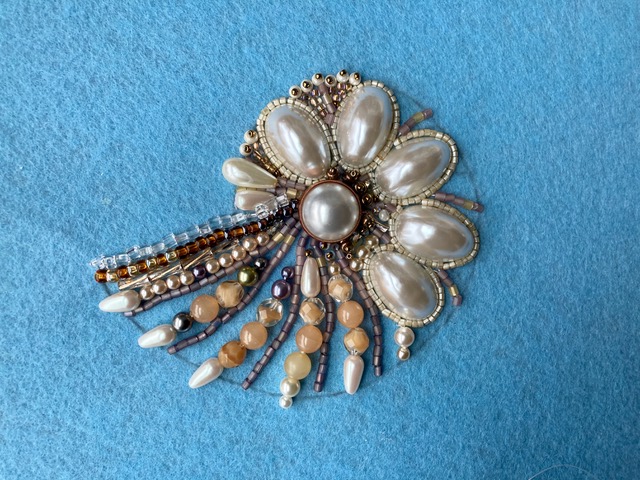
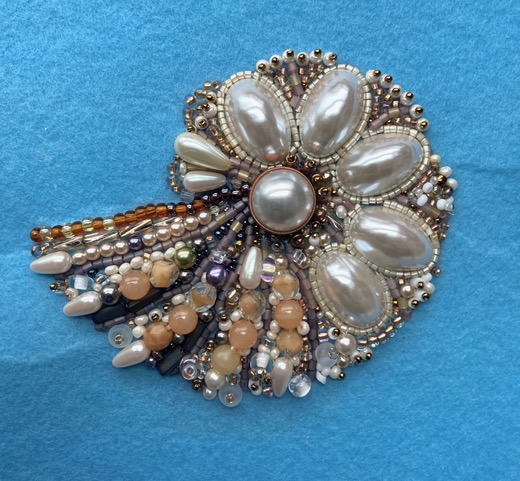
Nautilus - Toronto Bead Society 2024 Challenge

This year’s Bag of Beads Challenge had a lovely cohesive neutral theme spread across 16 ziploc bags. It was an elegant one, with unusual pearl cabochons (stumpers), large pearls set in copper bases (it is a finding, or a part of some fastener?), and fancy rhinestone cup chain on shaggy trim (stumper) plus thirteen (13) more bags of beads in all shapes and sizes.


Since I prefer beadweaving, I first tried bezelling around a pearl cabochon. Not easy when you’re working in thin air and don’t have micro beads to shape a bezel to hold a flat-backed pearl. Plus how do you finish the back which no one will probably see? 

Forget about my “Snowman Family” idea!


Next, I had an idea for an ammonite which would unfurl from the center to wider chambers which I could fill in with beads. Once I started the Google Image search for ammonites, I discovered nautilus fossils. Ammonites are usually shown cut in half to reveal the incredible inside while nautilus are 3-dimensional living fossils.

Fleshing out the idea — materials

I settled on Madagascar Direct’s Nautilus Fossils photo because of its graphic simplicity and coloration. I could visualize bead embroidering a nautilus using the beads in the TBS 2024 Bag. The website definition: “Nautilus fossils are the fossilized remains of ancient molluscs, a part of the cephalopod family along with octopuses, squid, and extinct ammonites.”

I printed out the nautilus photo in a few sizes to test out my idea of using the large pearl-set-in-copper in the center of the coiling and add five pearl cabochons to start the fossil spiral whorls. 

Now I had a ‘Master Nautilus’ photo to refer to while bead embroidering. I had artistic license for this Challenge, but needed reference for the shape and shading to be realistic.

I have always admired mosaics where the artist would incorporate unusual shapes and colors into their art and work around them. To me glass beads are like colored pieces of inlaid stone and glass. In 2010 I took a “Goddess Freeform Bead Embroidery Pendant” workshop with bead artist and teacher extraordinaire, Sherry Serafini. Learning creative beading around objects, creating textures by securing beads in different ways was a liberating experience which stayed with me forever!

Since this was going to be a 3-D bead embroidery full of texture, I needed a stiff ground to embroider on. It needed to be a blue color to showcase the iridescent nautilus. I bought a Good Felt Bead Foundation, which was described to be “a semi-stiff foundation on which beads are sewn to create bead embroidery designs. A needle glides through it, but it is stiff enough to support your projects without hoops or card backings.” (I was disappointed in the end when the weight of my nautilus caused some ‘cracks’/folds in the foundation.) 

I purchased my third 9x9 shadow box frame in a blond woodfinish from Michaels. It’s the perfect frame for 3-dimensional art because of the depth and canvas board for pinning.

At home I pulled out my 2024 Bag of Beads along with the leftovers from the TBS 2009 Challenge. The contents were in the same ivory tones, but had a few more interesting spares, i.e. butterscotch-colored rounds and facetted glass beads with a caramel-colored core. They came in handy for stitching onto the rest of the whorls of my nautilus.

I needed to test the placement of my nautilus in the frame, as well as figure out what I was going to do with the rhinestone cup chain trim.


Drawing a nautilus on the blue felt

Old school methods never die!! The best way to get the main lines onto the blue felt was to make a photo copy of my master. Next, cut along the main septa (color bands) to make thin channels for a pencil to draw lines on the felt.

TIP: When cutting lines with an Exacto knife or OLFA Multi-purpose cutter, use a self-healing mat. Press down the paper firmly as you cut slits along the lines. Rotate the paper to allow for smooth curved lines. STOP short so you have a stencil-like sheet without tears which you can position on top of the foundation. Cut a second line 1/8” (2mm) away from the first cut. Score both ends of each section and remove the paper line to reveal the slit.


I positioned the cut-out stencil on the blue felt foundation. I left the extra space above and below the nautilus for final tweaking in the end after my bead embroidery was done.

Using an old-fashioned wooden pencil, I carefully traced the lines between the slits. I was able to press firmly and had full control of the drawing the line. Mechanical pencil leads would break if pressed down too hard while drawing.

Next, I sized up the ‘master inspiration’ and frame. I connected the pencil lines on the felt for a smooth drawing. Then I reviewed the project and figured out a plan of attack.


Start of bead embroidery

I positioned the center pearl and pearl cabochon in position on the blue felt. For the record, this is where artistic license kicks in. The pencil lines on the felt were for reference only! It was up to me to try to reimagine a nautilus using the beads and stumpers in the bag. So here’s my bead embroidery story.

Thanks to a friend, I was told E6000 glue holds cabs to felt securely, so there is no need to decrease the bezelling as in my first test sample.

The outline of each pearl cabochon is purely decorative because the glue seal is strong after sitting to dry for 24 hours. I bead embroidered a bezel using the cylindrical lustre-coated ivory beads around each pearl cabochon so closely, I could not add a second or third peyote row even if I wanted! I was satisfied with the clean single bezel outline. 

Next, I used 8/o Hex beads from my stash to ‘draw’ the septa (dividing walls between chambers). I was ‘painting’ with bead colors following my Master photo reference. So, I played with matte grey, taupe and light gold Hex beads. It was interesting to note the names color assigned to the Hex beads by Miyuki because I perceived them to be as described. Color placement helped create a realistic rendition per my Master nautilus photo.


For the peristome edge where the tentacles and fine organisms reside, I uses the tri-color assortment of 6/o seed beads in one of the TBS bags. I carefully placed the the dark ones near the center core and lighter ones towards the lower edge. Note the transition using three colors of beads.


For the rest of the body chamber, my Master photo showed wider taupe-grey chambers. I used the large butterscotch beads from the challenge along with facetted caramel-cores from TBS 2009. I needed large beads to make the transition from the very high pearl cabs to the peristome edge. From the mixed bag of colored pearls, I stitched down some grey pearls at either end of the butterscotch rounds, then smaller grey ones to shape the body chamber. The last chamber has a mix of ivory pearls and grey. Size and color mattered.

Most of my bead embroidery was done on the sofa while watching (listening to) television. Working in a more reclining position with a tray of beads on my lap allowed me to take my glasses off for close-up work. I can see better where to position the beads and insert the needle, but have to put them back on for reference and picking up beads.

It was a constant on and off with glasses as I filled in other beads from the bag. Some beads, i.e. yellow-lined frosted chicklets were hidden under other bead to help create a textured shaped. The bronze-edged twisted Corolla bugles filled in the last chamber. I also added a smaller twisted one from my stash. I kept building the nautilus with beads of every description from each of the bags. In the end I added the really large crow beads with random placement on top of previous layers of texture for zing and dimension.

I thought I was finished late one night. I am showing of my finished Nautilus at 1:00 am.

The next morning I critically looked at my nautilus before framing it. The super textured lower portion overtook the sweeping nautilus whorl. I ripped off the glass triangle edge by the peristome edge. Then I proceeded to carefully add smaller ivory seed beads, metallic bronzes and stitching brass-lined crystal AB 10/o, 8/o and occasional 6/o seed beads to extend and shape the top pearl cabochon whorls. A few glass triangle on top added sparkle. In the end, I am satisfied with my bead embroidered nautilus.


Assembly for framing

Time to frame and deal with elephant in the room, the fuzzy rhinestone cup chain trim. This required figuring the best position for my beaded nautilus and where exactly the trim should be. Careful pencil guides marked where to cut off the excess blue felt and stitch the cup chain.

Following my penciled line, I stitched down the cup chain trim carefully by coming up between the rhinestone cups. This underlined the nautilus and took care of the requirement of using everything in the Bag of Beads.

Rechecked the positioning of my nautilus and cut off the excess blue felt. I used some E6000 glue again to hold the heavy bead embroidery to the back board and attempted to press down the felt fold ‘cracks’. To try to flatten out the background, I added a few thin pins into the folds. Thank goodness the shadow box frame come with a canvas board one can pin into!


Voila! My framed Nautilus and Master inspiration. Nice to know the glass of the shadow box will protect my beaded Nautilus, but it is impossible to photograph because of glass reflections. I’ll put the glass in after the Feb 14th REVEAL to the Toronto Bead Society.

Here I am pleased I completed the 2024 Bag of Bead Challenge and have a third shadow box Nautilus to add to my bead room gallery along with 2023 Mid Century Modern and 2023 Secret Garden.


Wednesday, February 9, 2022

Snowy Owl

Time once again for the Toronto Bead Society (TBS) Bag of Beads Challenge. At least one of everything in the kit has to be used in the challenge!! My first impression of the contents of the 2022 edition was hmmmm… How am I going to combine a circle of birch bark with a monster 16mm pearl ball and bugle beads?

Contents of 2022 Bag of Beads

Naomi Smith of Black Tulip Designs gleefully added a birch bark circle to her generous donation of seed and bugle beads for this year’s TBS challenge. By definition, the bark is the stumper as it does not have a hole in it. We’re a BEAD society!! A doughnut could be classified as a bead should you want to string it, but flat birch bark isn’t!

I moved on to the next challenge — the IDEA! “How could I incorporate the birch bark into my beadwork?” What is my theme? What could I embroider on the birch bark? 

Once the OWL idea popped in my head, I started searching for visual references. There were all sorts of owls out there. The most appealing one was the Snowy Owl drawing by Art by Three’s Sarah Rebekah Rachel White that had been uploaded on January 20th, 2020 to fineartamerica.com. My husband traced over a print out for a line drawing and then digitally reduced the size to fit in my circle. This allowed me to trace the main outline of the owl on my birch bark for filling in with bead and porcupine quill feathers

Snow Owl inspiration

NETTED COLLAR

The two sizes of black bugles begged to be netted, but first I had to play around with the placement, seed bead mesh points, top edge and lower trim for a smooth netted collar. We could add beads to the challenge. By adding brown iris 10/ seed beads in between the black bugles the overall netted collar would have character and be more compatible with the birch bark. 

Testing netting ideas

Since we had two months to work on our challenges, I took along several bead options  for the netted collar with me for our circle tour visit of family and friends over Christmas and New Year’s. We had plenty of spare time in Erie, PA. A desk with a window view and good music provided a creative space for designing and beading.

Good light, a view and space to work

In my stash, I found a sample pack of drop beads in a mix of colors. What a thrill to discover to how nicely the lower net edge looks when a single drop is centered along the lower edge of graduated bead sizes. I alternated the copper, matte black, gunmetal and shinny black along the lower edge in a pattern until I ran out of the copper and gunmetal. By wearing the collar front to back, the 4-color pattern would look great at the back.

Alternating drops

Then, I alternated the remaining matte and shiny black drops equally on both sides of the 4-drop repeat until I ran out those drops. I figured, a clasp on the all black ends would be hidden under the birch medallion and the all-black drops would make a great background for my owl.

Collar and inspiration

Serendipitously, the neck circumference using two 8/ seeds along the top edge fit perfectly right at the point I ran out of the drop beads for the lower trim! Someone was looking out for me!!

Perfect fit

BIRCH BARK CHALLENGE

First of all, it helps to use an awl to pierce holes in the birch bark, but be sure to have a cork base handy to soften the punches! 

Awl and cork base

I made holes just inside the circumference for use in the very end when I add a leatherette backing for a clean finish. I used the guides on the circle template for dividing the circle as evenly as possible and was satisfied the holes were well spaced for the edging finish at the end!


Since the body was too small for my selection of beads to be properly defined, I decided to partly bead embroider the large owl wing and the face. By using porcupine quills for the owl’s body I could achieve a modelled 3-dimensional effect.

Since the birch bark is more fragile, I figured I would be able to bead embroider freely on the leatherette, cut it out closely, and then add it on top of the birch bark to make a more realistic owl.

I had ivory leatherette material handy for backing the medallion when it was finished, but first, I cut off a small a piece of leatherette for embroidering the owl face and large wing with beads.


Inspiration with birch back and leatherette

I used the time-tested trick of shading the back of my proportioned owl print with a lead pencil. Then traced the outline of the owl on the bark, as well as the leatherette, with the awl. The markings came out clearly on both surfaces!

Preparing the transfer image

BEAD EMBROIDERY

I started embroidering the feathers with an assortment of bead shapes and colors. Each feather started with an ivory pearl 11/ seed, sand-lined crystal 11/seed, copper-lined cylindrical Toho, 3-cut topaz, 10/ brown iris. I staggered the feathers so they appeared long and distinct. Once the feathers were in place, I outlined the face with tinier beads. Inside I stitched around crystal AB 11/ seeds for a fluffy face and then added metallic gold “O” beads for the eyes. A tiny black seed bead holding the O in place became the pupil.

Beads for feathers

One row of feathers done

Three rows of feathers done


I trimmed the face-wing carefully not to cut any strings of feathers.

Testing fit of bead embroidered portion

PORCUPINE QUILLS

By using porcupine quills, I could easily create shaded feathers. The colors are naturally there. By carefully positioning the transition of colors between the holes was like painting feathers. Thanks to a 2013 workshop with Naomi, I learned how to work with porcupine quills and had a few spares. The important thing was to soak them so the quills could be bent and folded, as needed.

Porcupine quills

Soaking quills and birch bark ready to go

A few punched holes were a good start, but I needed to add new ones as each feather dictated.The burr end and the long white ends both cooperated as I pushed and pulled them to a pleasing feather-effect. The quills had to be fully dry before trimming the excess quill points.

Using awl to pierce birch bark

Placing first few feathers

Creating a nature feather pattern

Underside of birch bark before quills are trimmed

All the quills have been trimmed

Once they were trimmed, I positioned the beaded overlay next to the quill body and proceeded to stitch down the beaded feathers. This combined the two techniques in to one 3-D owl! I added little black claws between the quills to perch my owl.


ASSEMBLING THE BIRCH BARK MEDALLION


Ready to assemble

Using the bark circle as a template, I traced and cut a leatherette circle for the backing. Looking at the remaining beads in the TBS 2022 Bag, I noted which ones were still outstanding and needed to be incorporated in my creation. I tried using some of the coral pink 8/, and tried my own turquoise seed mix to tie it into the three large turquoise shapes in the bag! In the end, the best edging solution was to use two 8/ black beads along the edge anchored by the 10/ brown iris bead through every hole. Simpler is better!


Black edging in process

This was not the end because there were more beads which needed to be used!!


BACK STRING OF BEADS

Again, a review of what was left over in the TBS Bag revealed metallic pink barbell- shaped beads, 8/ matte salmon pink seed beads, two large turquoise-finished beads, a single turquoise larger potato-shaped bead with headpin loop, 5 - 16mm ivory pearls, a dozen of pear-shaped ivory pearl drops. 

Stringing some of the remaining beads for the kit

At least one of every one of these beads needed to be used in the challenge. I decided to string a strap for the owl medallion ending with single round 16mm pearl on each side followed by the turquoise. I checked my stash for large-shaped black beads to fill in between the metallic barbells and matte pinks. I used my diagonally-drilled Czech cubes and had to supplement the length with interlocking V-shaped beads. I added fine metallic peacock iris seed beads for zing between the pinks and blacks. This was strung on a beading wire with crimps added to secure a lobster clasp at each end. 

Netted collar, medallion and strap

BIRCH MEDALLION FRINGE TRIM

I added two soldered rings near the top of the medallion for the strap attachment. 

There still were large pear drops and the huge single turquoise on a head pin to deal with. The only place it made sense was in a fancy fringe trim of the circular medallion. I dropped down the turquoise bomb on a few seed beed in the very center below the owl. A single metallic peacock bead between black ones made a difference! I then added the pearl drops with metallic pink barbell wings on each side. Four fancy pearl drops each side of the gentle upward curve did the trick for balance and interest.

Medallion with trim and connected to strap

THE SNOWY OWL

When trying to model my creation, I found I needed another component to make it possible to hook on the strap to my medallion. Unfortunately, the color of my spring clasp does not match the gunmetal findings., The overall look is worth this minor  finding color oversight. 

Modelling all three components together   

Here I am modelling the three views of my Snowy Owl creation: the Netted Collar, the Owl Medallion and The Ensemble. 

Netted collar

Medallion attached to strap

All three together


I really enjoyed this challenge because it made me try new things and ideas. This is the only way to grow. I look forward to seeing and hearing stories of my fellow TBS members at the February 9th Reveal meeting.