pinterest pin it

Showing posts with label beaded. Show all posts

Saturday, August 22, 2020

Sunflower Mask

The Toronto Bead Society’s Mask Challenge for an Aug 12, 2020 Zoom meeting and a request for a “fantasy piece” for an upcoming bead exhibit at the Ukrainian museum converged into this Sunflower Mask!


The Ukrainian Museum of Canada Ontario Branch and our neighbours at the Native Canadian Centre of Toronto are planning a co-produced exhibit titled The Spirit of Beads: Sharing our Stories.

What could be more Ukrainian than sunflowers?? They are Ukraine’s national flower and represent the warmth and power of the sun, which was worshiped by pre-Christian Slavs.

Inspiration photo and bracelet

My husband found this photo of a vibrant rich field of sunflowers. A netted bracelet with a beaded sunflower on top by Ulana Bobyk from Lviv inspired my freeform flowers.

I wanted my sunflowers against a bright blue sky. Jo-Ann gave me the perfect piece of ultra-suede for the background and cotton fabric to match at a time when stores with non-essentials were closed. I was determined the sky should be smooth all across the top. No seams! Just a pinch at the bottom and gentle pleats were acceptable.

Next, for beading my "fantasy" mask and one based on regional beadwork for the museum, I wanted to expand my color palette and use charlottes, a seed bead with a cut which reflects light and makes the bead embroidery sparkle. Naomi Smith, Black Tulip Beads, came to my rescue and Charles even delivered the beads, and more beads, in two lots!


For the sunflower seed center, I started with a circle of six brown beads. I kept changing the color and type of bead for every rotation. Sometimes, I used one, or two beads in between those of the previous row. The seedy center grew and then I’d start stringing an assortment of yellow beads for each petal.

2 of 3 flowers pinned in place

I found it best to start with a yellow-orange or two beads first; then vary the finishes to a picot turn around. On my way down, I’d improvise with the mosaic stitch and color of beads. Then I'd anchor the petal and move on to string another combo for the next petal.

Testing the placement

There was a lot of trial and error. With safety pins securing my beaded sunflowers, I tried to see how many more I needed to bead, where to position them. Coincidentally, my calendar featured a sunflower mural for August, so it’s like this was meant to be! The extra fingers belong to my husband, the photographer.

Starting a leaf

I netted the leaves in many shades of green. I sketched the first row and kept playing with color placement and shaping the leaves into more realistic shapes. I repeated it a few times, but each leaf is a bit different as it is in nature.

Shading and shaping

The final layout

Once I had my components, came the “positioning the sunflowers” fittings. Here we see them stitched onto the flat ultra-suede. I trimmed away the corner to allow for shaping on my face and stitched the outline of the dart for the bottom of my mask. Then I positioned my leaves and stitched them down. 

Preparing the layers

I cut the cotton fabric a bit larger than the ultra-suede. I started off with the folded down edge along the top and lined it up with the straight mask edge. I back-stitched a dart in both fabrics and used a quilting technique to make the seam as flat as possible. 

Stitching it together 

The top was finger-pressed one way, the lining dart was pressed the other way. There was no bulk along the bottom edge when I tucked under the excess lining fabric. The sides were pleated last.

Detail of  3-bead edge

I decided to used a 3-bead finish to join the front and lining together in a single stitch. Once I figured out how to do the stitch and sequence of colors, I bead-finished the top edge. I chose to use lively warm Hutsul-colors of yellow-orange, orange and green. Once the top was stitched, I did the bottom and sides. I’m pleased the diagonal pattern worked out perfectly all around. 

Twisted cord ties

For ties I used DMC Mouline floss in matching traditional colors. There were several attempts to twist the thread like I used to with my mother. The twisted cord with three colors was quite thick when it was folded in half and twisted further upon itself. I felt it appropriate for tying on my mask since it’s the way finish of embroidered ‘sorochky’ (chemises) or beaded necklace for wearing.

Finished and ready for Zoom meeting

The Toronto Bead Society Mask Challenge Reveal meeting was right when we were on vacation in Kingston, ON. I finished each chord end with a tassel in the motel. Thank goodness I was able to participate in the Zoom meeting through my iPhone.

TBS Zoom meeting


This is my favorite kind on meeting, because we get hear everyone’s stories. The ideas behind their design and their creative process.

It was amazing to see the great variety of masks.

Monday, September 23, 2013

ABCs of Creativity - S is Seed Beads

There are two type of seed beads, the natural ones and glass drawn ones. Seed beads are small uniformly shaped beads that come in an enormous range of shapes, sizes, colours and finishes.

Czech seed beads with iris, silver-lined, matte painted stripe and opaque finishes.
From "Beader's Paint Box", 2013 seminar

I'm concentrating on the plethora of round seed beads made of drawn glass though there are many other styles, i.e. bugles, created by the described process. In the 15th century on the island of Murano near Venice, a hollow mass of glass was literally drawn or pulled into a long tube like taffy. This glass cane tube was then cut into small pieces to produce seed beads which were then tumbled to soften the edges and graded. The secret made its way out of Murano and a glass industry developed in the Bohemian forest and mountains of todays's Czech Republic.

A section from an engraving showing glass being drawn.
The plate is from Grands Hommes and Grands Faites de L'industrie, 1880.
courtesy of www.bigbeadlittlebead.com
New processes and machines were invented in the 1860s and bead makers were able to achieve uniformity of colors and size in beads. Since the end of the 17th century, Czech beads became a major production item. Bead became more accessible to the people in Europe and beadweaving and bead embroidery exploded. They also became a trade item to Africa and the Americas.

Chieftan's headdress with seed bead birds on beaded base. Yoruba, Africa
Seen at African Village Show in Tuscon, 2013 
Beadwork on souvenir items by Iroquois, Mohawks, Tuscarora. Note seed bead card.
Naomi Smith Collection, ON, 2005
"Gerdany" reproductions and original designs for sale at a Festival in Ukraine, 2013
 Netting and loomworked bracelets, chokers and a stylish "V'
courtesy of  Irena Halaschak on FB
In the early 20th century a machine was invented which automatically drew glass tubes. The Japanese seed beads industry developed in the mid 20th century and boasts a great variety of high quality seed bead styles and finishes. They created a cylindrical bead, i.e. Delica®, which has oversized holes for thread. These work well in mosaic-like (Peyote) stitching and generally are not interchangeable with round seed beads within the same piece. 

Round and cylindrical beads are sized by aughts, a number based on how many beads fit within a given measurement. The aught numbering system ranges from a larger 1/ to a very fine grain of sand 24/. 
Aught # on left. Note how many beads fit in a centimeter.
courtesy of Lisa on FB
Here is my Aught Bead Guide with historical names and modern uses:

1/ or 2/ = crow bead
3/ or 4/ = trade bead
5/ or 6/ = pony bead
6/ is a larger bead used for modern beadweaving and knitting
8/ = called “medium” bead in Rypan tutorials
8/ is a midway between the 6/ and 10/ or 11/ and used for modern  
             beadweaving and knitting
10/ or 11/ = fine beads used for beadweaving, knitting and embroidery
10/ seed is commonly used in First Nations beadwork and 'gerdany'-making
            10/ Czech is interchangeable with 11/ Japanese in Rypan patterns
11/ Japanese is a very common fine seed bead
11/ Czech seed bead is smaller than 10/
13/ = Charlotte bead has an additional facet to reflect light
15/ = very fine bead 
15/ is the smallest bead in modern production
18/, 20/, 22/ = very tiny beads which are no longer in production.
The higher the aught #, the tinier the bead. 
              These tiny seed beads are only in old beadwork in museums and collections worldwide
Czech 8/ medium sized; 6/ purple-lined pony; 2/ purple-lined crow;
Japanese 11/ silver-lined fine seed bead
 Wisteria Textured Net for narrated Netting Primer 
Rocailles are round seed beads with a lining inside the bead creating in Venice. These used to have a silver lining (s/l), but today refer to any type of color or metallic lining. Preciosa®, the largest Czech manufacturer still refers to the round seed beads as rocailles and divides them in uncoated and coated categories. Many undergo further finishes.
10/ s/l gold and brown rocailles with a touch of s/l blue on navy iris were used in M Rypan's netted kllim
This kilim was my first article,"Ukrainian Netting'', Bead and Button, Jun 2003
 Indigo Kilim kit or pattern, 2004
The round seed bead has two distinctly different shapes depending on manufacturer. The Czech seed beads are more donut-shaped and tend to stretch out a charted design within certain techniques, i.e. loomwork and pictorial mosaic. They are sold loose or strung in hanks. The Japanese beads are more square-ish with rounded corners. Never mix the two seed bead types within a beadwoven or loomwoven pattern because the shapes are distinctly different. Mixing different shapes and sizes is fine in stringing, some netting and herringbone styles.

Cylindrical beads are flat and fit nicely together in pictorial type of stitching, i.e. mosaic or loomwork. Because of their shape, they then to flatten out a charted pattern so you need to make many more repeats to reach your desired length.
Iva's Daisies  using Delica cylinder beads by M Rypan, 2003
Mosaic Daisies using 8/ seed beads by M Rypan
Mosaic Daisies kit, 2004
Innovations never cease. Now we have hybrid beads which where some Japanese beads are sent to the Czech Republic for their traditional finishes. This collaboration yields unique brilliant beads.Today’s description are lengthy because they makers are constantly experimenting with new finishes. Even transparent beads have AB coatings.

Start of a textured Herringbone with hybrid Picassa olive (Sour Apple) 6/,
#2 s/l amethyst, rainbow rosaline/op. purple-lined 11/, deep magenta-lined AB hex beads
The Sour Apple 6/ hybrid beads really give this herringbone zing
Beaded Soutache Herringbone kit, 2012

Finishes affect the perception of the bead especially when they are placed amongst other beads or backgrounds. Matte beads recede. The opaque color seem to come forward. Silver-lined beads reflect light. Transparent beads look great in windows with light behind them, but change drastically when against skin color or used in small doses within a beadwoven pattern.

Iris beads have and Aurora Borealis finish and no longer are limited to a few classic metallic finishes. 

Color placement of seed beads can totally alter the look and mood of a piece.
Netting with silver-lined red on green iris background by M Rypan
 Red Green Kilim kit, 2004

Same netting pattern with metallic gold on green iris. Note s/l red beads
Mediterranean Kilim kit, 2004


Making samplers to test best effect for Netted X's and O's using French 8/ seed beads
for Millefiori Netting X's and O's in ANPT, Summer 2012
Blue Chevron X's and O's kit, 2013
Lustered finishes reflect light. Ceylon pearls are more transparent and are affected by what’s around them. Op. white pearl is a brighter amongst other bead types.
Pearl-tipped Twig Cascade commissioned for Katrusia's wedding, 2012
Twig Chip Cascade Netting Pattern - downloadable 
Seed beads are brought to life by various techniques:
Bead embroidery on a sheep skin 'kyptar' vest from Bukovyna, Ukraine, 1950's
 Maria Rypan Collection, 2008
Bead embroider and 'tsyrka' whitework trim on 'sorochka' chemise
from Kitsman, Bukovyna region, 1950s
Nastasiya Marusyk Collection, IL 2007
Bead embroideed 'sorochka' using cut and round seed beads
from Kitsman, Bikovyna region, 1950's
Nastasiya Marusyk Collection, IL, 2007
Loomwork using colors of seed beads to recreate traditional embroidery pattern on left.
Stylized interpretations for contemporary medallion styles and swag finished 'gerdany'
Master Craftartist Maria Chulak, Pyadyky, Kolomyya region, Ukraine, 2006

Vanessa reinterprets the rose in the Diagonal weave, Bead Fx April 13
Top: 3-color Rhombic Medallion Pattern
Mid: Diagonal Rose Medallion Pattern


Color placement of the seed beads create a dynamic pattern
beaded by Barbara Glennon, NJ, 2011
based on M Rypan pattern in Netted Mesh Collars: Lessons #1
Original Zigzag netted collar with a three step increase with design created bicolour placement seed beads
Created for workshop at ROM in conduction with "Legacy of Scythian Gold" exhibit
Netted Zigzags downloadable pattern 
Netted Triple V's with silver-lined accent and contrast beads creating the design
 done in a vintage black iris bead by M Rypan
Triple V kit, 2000
Triple V pattern included in Jagged Mesh Net: Lessons #2 book
Beaded pysanky beadwoven with a variety of techniques. Several start off with netting. Some are squarestitched and tapered on ends with mosaic (Peyote)stitches
by Luba Frankevych, at Vernissage, Lviv, 2013

Color and beadweaving technique creates this style.
Start beading in the center. Add swags last.
 Deep V Cascade kit or pattern, 2001


Seed beads are donut-shaped and fall with the hole up making it easy to peck them and slide up onto needle when using a Chinet® paper plate surface. These plates enable beading to be a very portable activity when tucked into a ziplock bag along with a mini kit of beads, clippers, needle and thread.

Picking up bead tips in "Beadweaving Basics"on Maria's narrated Netting Primer 
Great guides for all types of beading: BigBeadLittleBead Find out how many beads you get per hank or gram.. What type of thread to use with different bead sizes.

It all starts with two or three different beads colours, a little beadweaving or embroidery and a touch of creativity... 

Happy beading!
Maria

Wednesday, February 13, 2013

ABC's of Creativity - C is Color

Visual presentation by Maria Rypan, 2012;
"Beader's Palette" by Jan Huling


"Beader's Paint Box" presentation for Creativ Festival Spring 2013
INDO Bracelet, Lariat & Earrings, Rypan Designs 

How do you get your beadwork to pop? Maria's presentations share a little bit of colour theory with lots of examples to show how to place bead colours, finishes and metallics against each other. The visuals make it possible to examine many variation and then apply what was learned in your beading. 

Color is a phenomenon of light or a visual perception that enable one to differentiate otherwise identical objects. It is described in terms of hue, lightness and saturation for objects; hue, brightness and saturation for light sources. Hue can be contrasted with black or white. (Miriam-Webster Dictionairy)

The relationships are best understood with color wheeels, a concept invented by Sir Isaac Newton in 1666.  These wheels from Color Matters show the basic concept.

Primary Colors. You can't stir beads to create the secondary or tertiary colors. But you can choose to place them according to the color wheel. These beads all have the same saturation. Black is not a hue. 
INDO Lariats have novel Indonesian lampwork beads, Rypan Designs 
Complementary. These beaded boxes use the very same hues, but vary in their color placement within the same design.
"Anemone Box Series" beaded by Jo-Ann Woolverton; inspired by Julia Pretl
Complementary. Using a bit of the opposite color on the wheel gives your beadwork zing.
"Wisteria" Textured Net, Rypan Designs

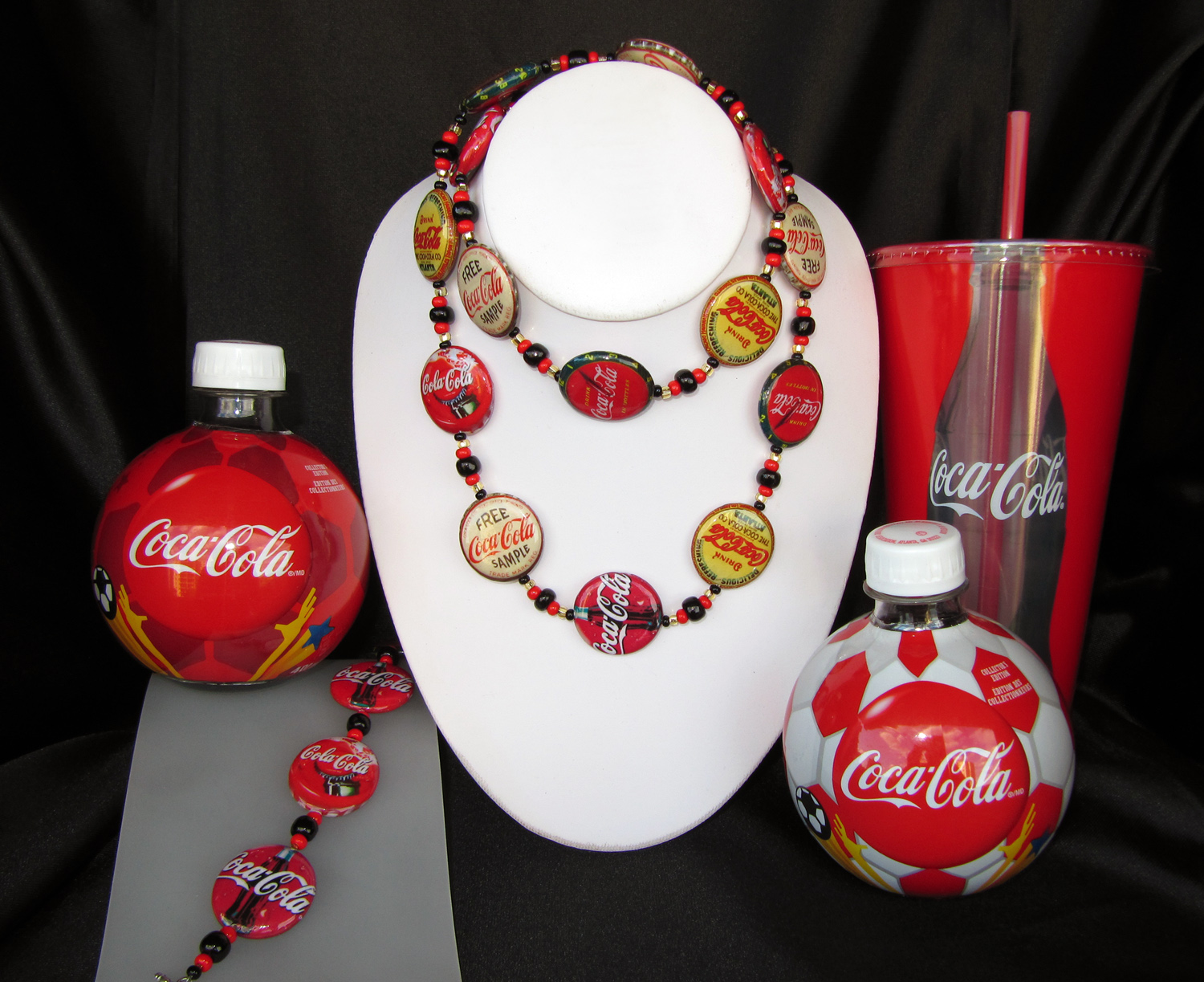
Analogous. Use colors next to each other on the wheel. These warm colors seem to advance.
"Coca Cola Bottle Caps" necklace and bracelet by Maria for friend Dolores
Monochromatic. Try tints and shades of the one color to make it interesting. These cool colors seem to recede.
Dangle Earrings using Swarovski ELEMENTS®, Rypan Designs 
This TBS Bag of Bead Challenge was full of opaque, transparent and  silver-lined TEAL seed beads. It also included the pressed glass, buttons and sequins.
Two pairs of complimentary beads were strategically placed to create the netted pattern. Note the playful color effects and turnaround beads in the strung fringe.

"Sedona Kilim",  Maria Rypan, 2000
Rainbow® Color Selector is a 5" wide tool which also comes in a Tonal Color version.
It's available from Fire Mountain Gems.
This ultimate color wheel was designed as a fundraiser by Ewelina Rzad. 50 beaders from Poland participated. Soutache and seed bead wrapped cabochons are tastefully layered into a collar. Each cabochon is a mini work of art. Light tinted red and purple hues create the 'V' which turns to cool colors on the right and morphs into warm colors on the left. 
"Tęczak - The Rainbow". CLICK to see how cabs were wrapped in soutache by the bead artists
Margie Deeb's bible for beaders
This is the only book of its kind written specifically for bead artists, The Beader's Guide to Color teaches beaders of all levels everything they need to know about color to create unique and vibrant beadwork designs. Author and artist Margie Deeb discusses in depth the psychological and symbolic associations of all the colors of the spectrum, and the ways in which color can be used to create and accentuate pattern, rhythm, and movement. Twenty-one color schemes are described and illustrated in detail with accompanying projects. 
Playing with color is fun!