pinterest pin it

Showing posts with label inspiration. Show all posts

Friday, May 7, 2021

Still Life Dichroic Brooch

Thanks to my Tuesday afternoon Beading Circle for challenging me to create something fresh. Our Zoom meetings are a great opportunity for beady friends to compare notes, share bead trivia, discuss beading technique, spotlight new designers and patterns. Everyone is beading at home with their stashes nearby. Its fun to do bead along projects.

When the idea of doing a beaded brooch in April arose, folks assumed this would be a bead embroidery challenge. Someone suggested to peruse one’s stash for a button or cabochon as the starting point for a brooch focal. I did not have any buttons.

I’d like to share my creative process of my Still Life Dichroic Brooch.

DICHROIC FRAME ART
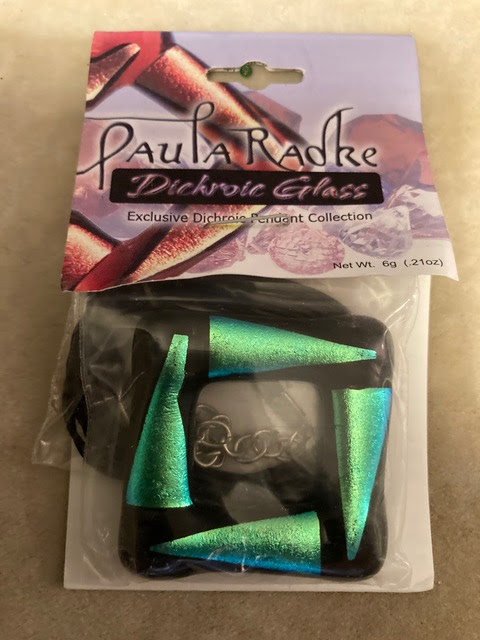
I did have a dichroic lampwork square frame pendant kit by Paula Radke from way back when I was participating in international bead shows in the late 2000s - early 2010s. I never strung the frame to wear, so it was perfect for my brooch!!


I envisioned the dichroic square as a frame for a miniature artwork. Google is full of images of paintings for inspiration! Rainbow Ridge - Colorful Landscape by Julie Brugh Riffey spoke to me. 


I poured a little of every intensely-colored charlotte 11o beads onto a Chinet® plate for painting with beads with the Ndebele technique.


I managed to recreate the feel of Rainbow Ridge one bead at the time. My beaded interpretation is dancing in the frame because of the shadows created by beads sitting at herringbone angles and the charlotte-cut of the beads which reflects light.


STILL LIFE 

Next, I used the leftover unique black-copper bead from the TBS 2021 Bag of Bead Challenge for a vase. Using the daisy stitch I filled the vase with beaded red and scarlet flowers.


To make sense, I decided to create a still life composition with my two main elements. Again, I looked through artwork on the internet for ideas. How do I show surfaces, light and shadows using beads? The artwork needs to be hung on the wall. The vase of flowers needs to be placed on a table.


TILA WALL

While scrounging around my stash I found a few surprises. I forgot I bought four tubes of Miyuki Tila Bead. Also, I purchased an assortment of microscopic seed beads from Bead Cats  in sizes 16o to 24o. I knew I had bugle beads in different sizes for creating the tabletop. 

The flat tile-shaped 2-hole Tila beads were ideal for creating a wall. I played around with square-stitching one tile to another and stringing a wonderful bronze-lined 15o seed bead between stacks of tiles. 


The wall grew tall and wide around the frame. The stepped down tile wall reminds me of Art Deco.
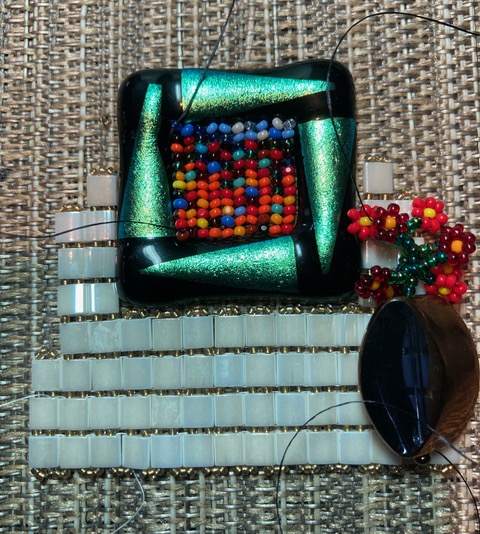
 

I had to work out how to assemble my beadwoven art in the frame, how to stitch my wall down. To create the brooch I needed some foundation to stitch and secure it to. I ordered a stiff felt beading foundation and a faux leather for a backing for my brooch from i-Bead

NETTED FLORAL TRIM 

I wanted my still life tablecloth to have a floral design. This is where the microscopic seed beads can in handy. The top of the netted tablecloth has microfine vintage bugles meeting up at the bronze-lined seed bead.

I found these would be a safe bet to connect the netted trim to the foundation. I sketched out a netted design in colored pencils. Clever color placement made it look like flowers with leaves. 

Each row of this vertical net is finished in a picot trim. The floral pattern was made to the width of the Tila wall.


Now was the time to stitch down the wall to the foundation. I cut out a rectangle of stiff felt, placed the netted tablecloth and calculated how high should the wall be placed.

How much space to I need for my bugle tabletop between the two?

BUGLE TABLE

I marked where to stitch the seed bead for the top of my netted tablecloth. This way everything was perfectly spaced. 

The wall was stitched down along the seed beads between Tilas. I then laid out the different colors of bugles trying to capture the light and depth of a table top.

TIP: To keep the color sequence intact for reference, take clear tape and press down on the bugle layout. The sticky tape will pick up the bugle rows as a single unit. Place it up higher for reference to see which bugle to pick and stitch them permanently in place. 

HANGING THE PICTURE FRAME

Then, it was time to hang up the picture. Luckily, there was a space on the wall for the frame. First, I traced the inside of the frame to know the positioning of the herringbone-stitched picture. I stitched my artwork to the foundations by stitching randomly between the beads.


To secure the frame to the foundation, I used a single continuous line of Aileen’s glue. Then I pressed down the dichroic frame in position on top the glue. 

Once the glue dried, I stitched down the corners of the frame carefully not to break up the dichroic triangles design. I used single strings of fine black beads to stitch down each corner.  Then I reinforced them with extra stitches close to the bead strings. This way the glass frame is securely part of the foundation, an important consideration since I will need to add a brooch pin to wear!


Time to add the vase on the tabletop. The tail below the stop bead at the bottom of the copper vase was handy for securing through the tabletop bugle row. I then had to go up through the vase to secure the odd-shaped copper bead. The remaining thread from the daisy flowers was used to stitch down the flowers in a few places. 


To balance the composition, I created another vase using an incised Indian bead as the vase. Petal beads in my stash came in handy to create an exotic bloom. By stringing a 15o between each petal I was able to create a flower. It is topped with a melon bead with a coral turnaround bead for zing. This vase was positioned on the tabletop and stitched down to the background.

BROOCH PIN

Thanks to Naomi Smith of Black Tulip for sharing her technique of attaching vintage pins to brooches. I borrowed the pin from my Bead Poppy I beaded in her workshop. 


TIP: For a discreet brooch clasp, I centered and stitched across the 1” strip 1/4” down from the top of the faux leather backing. This was to prevent the vintage brooch pin from riding up too high.

BACKING

The brooch needed a backing for a tidy finish. I used faux leather which was really nice to work with. I cut it out in the same shape as the foundation. Also, I cut out a 1” wide x 3-1/4” brooch pin holder strip.

Time to start stitching the backing onto the foundation. For every stitch I added the 15o seed bead. This created a fine smooth discreet bead edge. The 1” strip was stitched together the backing. When I started stitching up near the black frame, I quickly recalled a tip to darken the edge.


TIP: Use a Permanent Sharpie marker to tone down the white foundation edge.
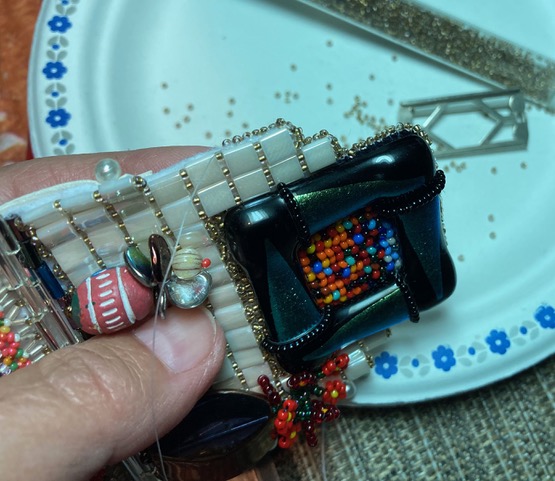

The bead edge-stitching continued down to the bottom and along the lower edge underneath the netted floral. The lower edge of the brooch pin strip was trimmed even to the lower edge and stitched together with the backing. The bead edge continued up to meet the start.

I slipped in the brooch pin under the strip ready to wear. I’m pleased my brooch is balanced and comfortable to wear.


Friday, July 10, 2020

Beaded Square Project: "Divine Liturgy Online"


As I was scrolling through my news feed on Facebook, a call for submissions popped up from the Museum of Beadwork in Portland, Maine. First time I'm hearing about this one... I've visited the Bead Museum in Washington, DC back in 1990s, then the one in Glendale, AZ in 2000. Even donated a set of my Beadwork Lesson books to both libraries. Both of these museums are no more, but someone else is trying again! 

The Museum of Beadwork is a new collaborative effort with Caravan Beads who have been around since 1991. The Museum "is mounting a new community project which grows out of a desire to commune on a joint project while safely sheltering; marking this very particular time we are going through together, apart. The end result, which will be exhibited at the Museum of Beadwork, will be a bead based ‘quilt’ visualizing the individual and communal experience of this distinct moment in history." 

They asked for a 6" (25x25cm.) square of beadwork, no matter what style, technique or experience covering more than 50% of the surface. It should be mounted on a strong supporting material to facilitate hanging in the 'quilt' installation. This is where a spare shelf from an Ikea CD/video storage unit came in handy. 

I must support the Museum by participating in the new Beaded Square Project! What can I contribute?? How have I been affected? As everything was totally shut down, so were the churches, places of worship. It was a huge shock, but somehow through online Liturgies, Lenten and Easter services, we persevered.

Finished piece in front of my parish, St. Demetrius Ukrainian Catholic Church, Toronto

Once I knew that I was going to create a square about the closure of the churches it was time to find inspiration in my collection of beads and beaded objects. 

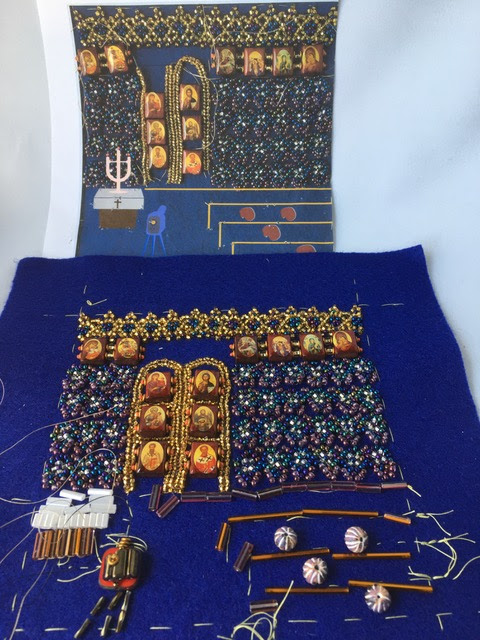
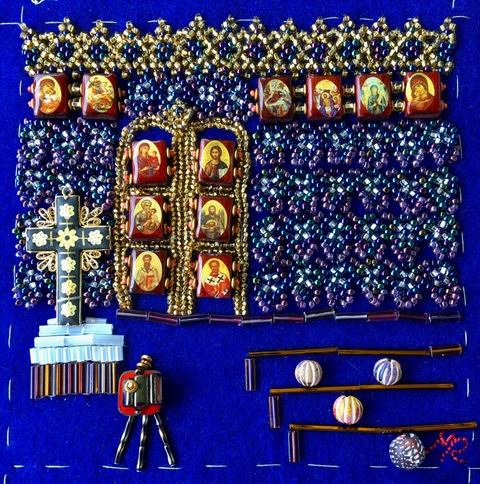
The wooden bracelet tiles would help to create the interior of a Byzantine church. They would serve as my icons, windows to heaven. They were perfect for creating an iconostasis, the screen which separates the sanctuary from the main part of the church. Closed Royal Doors with a few icons each are the focal point. Services begin when they open, so the camera off to the side is ready to video record the service. Bugles could serves as pews and a few people distanced apart could be added for when the churches opened slowly for a small congregation spaced far apart. 

Icon bracelet will serve a higher purpose

My previous sewing experience came in real handy! I used a royal-coloured felt square for my base. Fortunately, I had a large double-side backing paper handy. Once it was cut to 6" x6" size, I adhered it to the back of my felt leaving wider margins for the final finish later. I basted around the adhered backing to be able to know my boundaries when working on the front of the square.

Basting guidelines

Couching beadwoven netting to the felt

Bead embroidery is daunting! I rummaged through my bead woven samples to see if I had something to fill in the background of my iconostasis between the icons. I was thrilled to find a 8/ gold and navy iris 'Netting with an X' sample which would be perfect to couch down along the top of my square. This set the heavenly tone. 

Another great find was my 'Picot with an X' necklace. If I cut it apart in 3-swag segments it could fill in the left of the Royal Doors, while 6-swag pieces were perfect for the right. This involved adding thread to properly secure the edges of each segment so I could move them freeing without pulling apart.

Cutting old beadwoven necklace into useable lengths

Working on the layout

For the frame of the Royal Doors, I used the Ndebele stitch to bead weave two pairs of herringbone stitches in a length to the top of the icons. Here I split and beaded on one pair at the time long enough to go down the other side of door panel. Repeated this for the other door panel.

To combine the wooden icon tiles into cohesive units, I added an 'O' bead at each hole opening. I use a large silver-lined gold crow bead between the four and two icons. I used a little coral 10/ seed bead as a turn around at the very end of the icon clusters. I used the same end trim for individual icons set into the royal doors on the Ndebele gold door frame was stitched down.

Work in progress with my layout image to guide me

For a better idea of how the square will look, we cut out a 6' window in a sheet of paper. As I overlaid it, I took several photos of my beadwork as I was working. My husband downloaded one and drew out my key elements from my sketch in Photoshop. Since this was a more realistic scene. I wanted to have perspective to draw the viewer's eye in. 

This print was handy for making tailor tacks to mark the positioning of the pews, side tetrapod table, camera. This too was from sewing world when I used to tailor tack marking on patterns for making darts in my clothes.

Beadweaving a cross for the design

I needed to bead weave additional picot swags to fill the spot between the rows of icons and above the Royal doors.

It took three tries to bead a miniature Byzantine cross. I used Right Angle Weave, but found the challenge was how to give it definition. Weaving in microscopic navy iris cylindrical beads at the corners of each cross arm did the trick. I then attached my cross to the top two beads of the door frame in front of the patterned background.

To create the tetrapod, a small table off to the side, I found some chicklet pressed glass beads from retired bracelet and twig necklace kits. I ladder stitched 10mm two-tone silver lined chicklets for the base. Then I stitched together 5mm pearlized ivory chicklets for the folded over cloth. For the tablecloth, I horizontally stitched down longer chicklets going back to pearlized bugles to try to suggest depth. 

I added a crucifix I used to wear as a teenager. In my view, having it as part of my beaded square for the Museum installation, it's gone to a good home.

Signed and ready to be attached to a board

I embroidered my initials in the lower right corner to sign my little beaded work of art. After double, triple checking, it was time to wrap the beaded felt around the sawed down board. 

Test fit

We added double-sided tape along the top edges to anchor the embroidery. Once we turned it around, we added double-sided tape along the back edges to hold in place while I mitered the corners and trim away excess fabric. Again, I had the perfect royal blue thread for stitching down the corners.

Securing to the board

Once I stitched it all together, I went to show my completed square to Rt. Rev John Tataryn, pastor of St. Demetrius the Great Martyr Ukraine Catholic Church. Father marveled at all those tiny beads and the time and eyes it took to created the square. He suggested to call it "Divine Liturgy Online".

Finished and ready for shipping

Here is my statement that I included with my Beaded Square:
When the pandemic hit, the closure of churches was devastating. Luckily, many churches were able to adapt to streaming religious services, so we, the parishioners, could keep our faith alive in our own Domestic Church.

Be creative and stay safe,
Maria

Saturday, June 27, 2020

"Pandemic 2020" beaded pysanka

"Pandemic 2020" by Maria Rypan

This beaded pysanka was created for the Toronto Bead Society Spring/ Summer 2020 Palette Challenge. To get members to be creative during the pandemic, beaders needed to create something using colours in the forecast swatches.

Palette, beads, graph paper & coloured pencils
This is my first beaded pysanka ever and a fitting remembrance of how the coronavirus affected our world. My trip to bring an exhibit of North American Pysanky to Ukraine in April 2020 was cancelled. The egg, a symbol of life, is an appropriate background for my story!

Using 3-bead netting I created nurses' caps with Red Crosses to honour the front-line medical workers. A net symbolizes protection. So, the netting technique around the egg invokes safeguarding ourselves from the pandemic.

Red crosses were added on top of the nurses hats before zipping into a tube to slide over the egg.
Colourful homemade masks circling the pysanka are synonymous with caring and sharing protection with family and friends so we can go out safely for necessities.

The red threads were to help with alignment when assembling the beaded sections
The top started with a circle of 7 beads.
Since the repeat pattern worked out to seven nurses hats, that was the magic number for circular netting on top and on the bottom. I found creating motifs helped tremendously in designing the net increases one row at a time. Will it be 3-, 5- or 7-beads to shape the pointy top net or flatter bottom?

White daisy chain being added.
Daisies all around symbolize innocence and purity. These are all the children whose world has turned upside down. 

Another daisy chain to add to the flatter circular net at the bottom.
  14 flowers represent quarantine. As they bloom, they are socially distanced from one another.

Safely pins assist in joining my pysanky sections.
I like how the lilac looks between the daisy chain and the circular net.

The top needed some 3-D embellishing.
Let my beaded pysanka be a reminder of how the whole world stopped still. Going forward, in the NEW normal, let's cherish our freedoms and people more.

Thanks to a COVID blessing, my Rypan Designs website has been updated! There's 25 years worth of inspiration and resources for learning how to bead weave your very own creations.

Be creative and stay safe,
Maria

Monday, May 6, 2013

ABC's of Creativity - I is Internet

Internet is defined as a vast computer network linking smaller computer networks worldwide (usually preceded by the ). The Internet includes commercial, educational, governmental, and other networks, all of which use the same set of communications protocols.(dictionary.com)

For many of us the Internet is a distraction but it is also as source of information and inspiration.

Here are some of my favourites -

Beading Daily

Beading Daily is a daily newsletter, but the website has a wealth of great beading stuff. Videos, free projects and forums.

Pinterest

Pinterest is sharing community. Follow your fellow bead artists, favorite bead designers and friends. You can also browse other pins by topic and repin your favourite. Follow Maria and myself.

YouTube

YouTube is great for those who are visual learners. You can search for specific topic or techniques. You can also follow channels created by designers and producers. The School of Beadwork featuring Melanie Potter is a great channel. Create Your Style with Swarovski Elements has just started a new feature The Professor of Crystals.

Here is Maria's video demo of Diagonal Weave.


Interview of Maria by Mona Hair .


Blogs by bead designs and artists are a great source of information and inspiration. I follow many bead related blogs but here are a few of my favorites -

Beadfx (Beadful Life), Canadian bead store - beadfx.blogspot.ca/

Cindy Holsclaw (Bead Origami), American beadwork designer - beadorigami.blogspot.ca/

Kerrie Slade, British beadwork designer - kerrieslade.blogspot.ca/

Lori Anderson (Pretty Things), American beadwork designer and blog hop hostess - www.prettythingsblog.com/

Marcia De Coster (Mad Designs), American beadwork designer - maddesignsbeads.blogspot.ca/

Mortira vanPelt (Inspirational Beading), Canadian beadwork designer - inspirationalbeading.blogspot.ca/

Do you have a favorite blog or website? Share it with us in the comments.

Hope that you find inspiration online!

Happy Beading!!