pinterest pin it

Showing posts with label beading. Show all posts

Saturday, August 22, 2020

Sunflower Mask

The Toronto Bead Society’s Mask Challenge for an Aug 12, 2020 Zoom meeting and a request for a “fantasy piece” for an upcoming bead exhibit at the Ukrainian museum converged into this Sunflower Mask!


The Ukrainian Museum of Canada Ontario Branch and our neighbours at the Native Canadian Centre of Toronto are planning a co-produced exhibit titled The Spirit of Beads: Sharing our Stories.

What could be more Ukrainian than sunflowers?? They are Ukraine’s national flower and represent the warmth and power of the sun, which was worshiped by pre-Christian Slavs.

Inspiration photo and bracelet

My husband found this photo of a vibrant rich field of sunflowers. A netted bracelet with a beaded sunflower on top by Ulana Bobyk from Lviv inspired my freeform flowers.

I wanted my sunflowers against a bright blue sky. Jo-Ann gave me the perfect piece of ultra-suede for the background and cotton fabric to match at a time when stores with non-essentials were closed. I was determined the sky should be smooth all across the top. No seams! Just a pinch at the bottom and gentle pleats were acceptable.

Next, for beading my "fantasy" mask and one based on regional beadwork for the museum, I wanted to expand my color palette and use charlottes, a seed bead with a cut which reflects light and makes the bead embroidery sparkle. Naomi Smith, Black Tulip Beads, came to my rescue and Charles even delivered the beads, and more beads, in two lots!


For the sunflower seed center, I started with a circle of six brown beads. I kept changing the color and type of bead for every rotation. Sometimes, I used one, or two beads in between those of the previous row. The seedy center grew and then I’d start stringing an assortment of yellow beads for each petal.

2 of 3 flowers pinned in place

I found it best to start with a yellow-orange or two beads first; then vary the finishes to a picot turn around. On my way down, I’d improvise with the mosaic stitch and color of beads. Then I'd anchor the petal and move on to string another combo for the next petal.

Testing the placement

There was a lot of trial and error. With safety pins securing my beaded sunflowers, I tried to see how many more I needed to bead, where to position them. Coincidentally, my calendar featured a sunflower mural for August, so it’s like this was meant to be! The extra fingers belong to my husband, the photographer.

Starting a leaf

I netted the leaves in many shades of green. I sketched the first row and kept playing with color placement and shaping the leaves into more realistic shapes. I repeated it a few times, but each leaf is a bit different as it is in nature.

Shading and shaping

The final layout

Once I had my components, came the “positioning the sunflowers” fittings. Here we see them stitched onto the flat ultra-suede. I trimmed away the corner to allow for shaping on my face and stitched the outline of the dart for the bottom of my mask. Then I positioned my leaves and stitched them down. 

Preparing the layers

I cut the cotton fabric a bit larger than the ultra-suede. I started off with the folded down edge along the top and lined it up with the straight mask edge. I back-stitched a dart in both fabrics and used a quilting technique to make the seam as flat as possible. 

Stitching it together 

The top was finger-pressed one way, the lining dart was pressed the other way. There was no bulk along the bottom edge when I tucked under the excess lining fabric. The sides were pleated last.

Detail of  3-bead edge

I decided to used a 3-bead finish to join the front and lining together in a single stitch. Once I figured out how to do the stitch and sequence of colors, I bead-finished the top edge. I chose to use lively warm Hutsul-colors of yellow-orange, orange and green. Once the top was stitched, I did the bottom and sides. I’m pleased the diagonal pattern worked out perfectly all around. 

Twisted cord ties

For ties I used DMC Mouline floss in matching traditional colors. There were several attempts to twist the thread like I used to with my mother. The twisted cord with three colors was quite thick when it was folded in half and twisted further upon itself. I felt it appropriate for tying on my mask since it’s the way finish of embroidered ‘sorochky’ (chemises) or beaded necklace for wearing.

Finished and ready for Zoom meeting

The Toronto Bead Society Mask Challenge Reveal meeting was right when we were on vacation in Kingston, ON. I finished each chord end with a tassel in the motel. Thank goodness I was able to participate in the Zoom meeting through my iPhone.

TBS Zoom meeting


This is my favorite kind on meeting, because we get hear everyone’s stories. The ideas behind their design and their creative process.

It was amazing to see the great variety of masks.

Friday, July 10, 2020

Beaded Square Project: "Divine Liturgy Online"


As I was scrolling through my news feed on Facebook, a call for submissions popped up from the Museum of Beadwork in Portland, Maine. First time I'm hearing about this one... I've visited the Bead Museum in Washington, DC back in 1990s, then the one in Glendale, AZ in 2000. Even donated a set of my Beadwork Lesson books to both libraries. Both of these museums are no more, but someone else is trying again! 

The Museum of Beadwork is a new collaborative effort with Caravan Beads who have been around since 1991. The Museum "is mounting a new community project which grows out of a desire to commune on a joint project while safely sheltering; marking this very particular time we are going through together, apart. The end result, which will be exhibited at the Museum of Beadwork, will be a bead based ‘quilt’ visualizing the individual and communal experience of this distinct moment in history." 

They asked for a 6" (25x25cm.) square of beadwork, no matter what style, technique or experience covering more than 50% of the surface. It should be mounted on a strong supporting material to facilitate hanging in the 'quilt' installation. This is where a spare shelf from an Ikea CD/video storage unit came in handy. 

I must support the Museum by participating in the new Beaded Square Project! What can I contribute?? How have I been affected? As everything was totally shut down, so were the churches, places of worship. It was a huge shock, but somehow through online Liturgies, Lenten and Easter services, we persevered.

Finished piece in front of my parish, St. Demetrius Ukrainian Catholic Church, Toronto

Once I knew that I was going to create a square about the closure of the churches it was time to find inspiration in my collection of beads and beaded objects. 

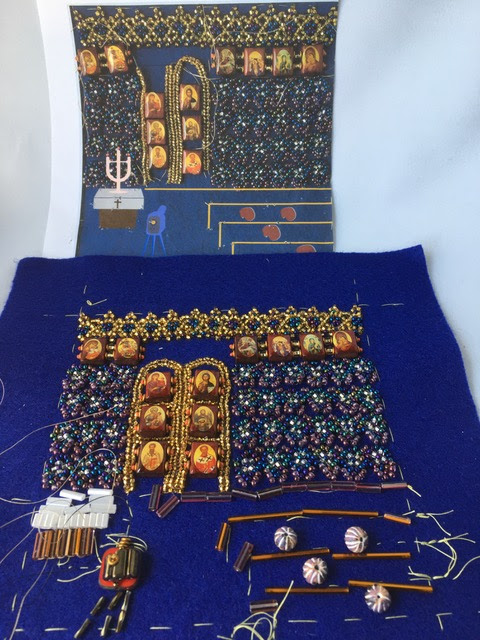
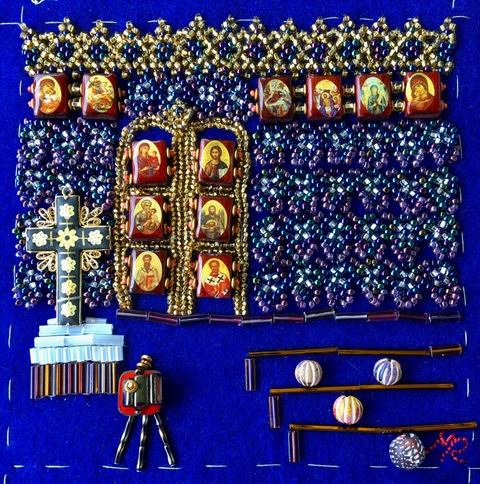
The wooden bracelet tiles would help to create the interior of a Byzantine church. They would serve as my icons, windows to heaven. They were perfect for creating an iconostasis, the screen which separates the sanctuary from the main part of the church. Closed Royal Doors with a few icons each are the focal point. Services begin when they open, so the camera off to the side is ready to video record the service. Bugles could serves as pews and a few people distanced apart could be added for when the churches opened slowly for a small congregation spaced far apart. 

Icon bracelet will serve a higher purpose

My previous sewing experience came in real handy! I used a royal-coloured felt square for my base. Fortunately, I had a large double-side backing paper handy. Once it was cut to 6" x6" size, I adhered it to the back of my felt leaving wider margins for the final finish later. I basted around the adhered backing to be able to know my boundaries when working on the front of the square.

Basting guidelines

Couching beadwoven netting to the felt

Bead embroidery is daunting! I rummaged through my bead woven samples to see if I had something to fill in the background of my iconostasis between the icons. I was thrilled to find a 8/ gold and navy iris 'Netting with an X' sample which would be perfect to couch down along the top of my square. This set the heavenly tone. 

Another great find was my 'Picot with an X' necklace. If I cut it apart in 3-swag segments it could fill in the left of the Royal Doors, while 6-swag pieces were perfect for the right. This involved adding thread to properly secure the edges of each segment so I could move them freeing without pulling apart.

Cutting old beadwoven necklace into useable lengths

Working on the layout

For the frame of the Royal Doors, I used the Ndebele stitch to bead weave two pairs of herringbone stitches in a length to the top of the icons. Here I split and beaded on one pair at the time long enough to go down the other side of door panel. Repeated this for the other door panel.

To combine the wooden icon tiles into cohesive units, I added an 'O' bead at each hole opening. I use a large silver-lined gold crow bead between the four and two icons. I used a little coral 10/ seed bead as a turn around at the very end of the icon clusters. I used the same end trim for individual icons set into the royal doors on the Ndebele gold door frame was stitched down.

Work in progress with my layout image to guide me

For a better idea of how the square will look, we cut out a 6' window in a sheet of paper. As I overlaid it, I took several photos of my beadwork as I was working. My husband downloaded one and drew out my key elements from my sketch in Photoshop. Since this was a more realistic scene. I wanted to have perspective to draw the viewer's eye in. 

This print was handy for making tailor tacks to mark the positioning of the pews, side tetrapod table, camera. This too was from sewing world when I used to tailor tack marking on patterns for making darts in my clothes.

Beadweaving a cross for the design

I needed to bead weave additional picot swags to fill the spot between the rows of icons and above the Royal doors.

It took three tries to bead a miniature Byzantine cross. I used Right Angle Weave, but found the challenge was how to give it definition. Weaving in microscopic navy iris cylindrical beads at the corners of each cross arm did the trick. I then attached my cross to the top two beads of the door frame in front of the patterned background.

To create the tetrapod, a small table off to the side, I found some chicklet pressed glass beads from retired bracelet and twig necklace kits. I ladder stitched 10mm two-tone silver lined chicklets for the base. Then I stitched together 5mm pearlized ivory chicklets for the folded over cloth. For the tablecloth, I horizontally stitched down longer chicklets going back to pearlized bugles to try to suggest depth. 

I added a crucifix I used to wear as a teenager. In my view, having it as part of my beaded square for the Museum installation, it's gone to a good home.

Signed and ready to be attached to a board

I embroidered my initials in the lower right corner to sign my little beaded work of art. After double, triple checking, it was time to wrap the beaded felt around the sawed down board. 

Test fit

We added double-sided tape along the top edges to anchor the embroidery. Once we turned it around, we added double-sided tape along the back edges to hold in place while I mitered the corners and trim away excess fabric. Again, I had the perfect royal blue thread for stitching down the corners.

Securing to the board

Once I stitched it all together, I went to show my completed square to Rt. Rev John Tataryn, pastor of St. Demetrius the Great Martyr Ukraine Catholic Church. Father marveled at all those tiny beads and the time and eyes it took to created the square. He suggested to call it "Divine Liturgy Online".

Finished and ready for shipping

Here is my statement that I included with my Beaded Square:
When the pandemic hit, the closure of churches was devastating. Luckily, many churches were able to adapt to streaming religious services, so we, the parishioners, could keep our faith alive in our own Domestic Church.

Be creative and stay safe,
Maria

Tuesday, December 17, 2013

ABC's of Creativity - Y is Yarn

Yarn is defined as a long continuous length of interlocked fibres, suitable to use in the production of textiles, sewing, crocheting, knitting, weaving. Since I’m approaching this from the beading angle, I’d like to present a few examples of how yarn is used as the carrier of beads and show a few examples of how the combination works. 
"Bobbles by the Yard" by Flo FLory
Project in A Needle Pulling Thread, Summer 2011

I’ve been told the beads have to be put onto the yarn before beginning to knit or crochet. This is something that needs to be prepared in advance. You can use and finer thread and needle to hook your yarn into a folded knotted thread OR use a split needle to catch the yarn and string seed beads for your project.
"Threading beads", Knitting with Beads,
www.vogueknitting.com
VOGUE Knitting has an excellent intro to Knitting With Beads. There are two ways: random or planned placement called “beaded knitting” where the beads fall over the stitches rather than between them. There's the stockinette and the slip stitch method for single beads embellishment of knitting.
"From the wrong side", Kntting with Beads,
www.vogueknitting.com
'From the right side", Knitting with Beads,
www.vogueknitting.com
The other was is ”bead knitting” where the beads are placed between each stitch for a solid beaded look. I haven't found a video tutorial on bead knitting. Guess you'll need to take a class with Flo and learn from a master.

Knitting with beads was developed in the 18th and 19th centuries and used for purses of other elaborately decorated items. It’s called “bead knitting” or “purse knitting”. It is created by placing on bead between each stitch, so that the knitting stitches are completely hidden by beads. Intricate patterns can be created in bead knitting by threading beads in reverse of the design which  must be completely accurate.

"Hearts", knitted reticule by Flo Flory, ON
I have had an opportunity to get a closer look and feel at Bead Knitting through fellow Toronto Bead Society member, Flo Flory’s work. Flo designs and teaches bead knitting and was kind enough to come over with her beadwork when I was preparing an inspirational visual presentation, “Beadwork: The Most Versatile Art Form” in Oct. 2011. Better yet, it was great when we were able to pass around her finished knitting work during my presentation. Folks got to feel how soft and fluid the purses and accessories were. The larger the piece, the heavier it gets because uses glass Czech see beads for knitting. Haven't found a video tutorial on bead knitting. Guess you'll need to take a class with Flo and learn from a master.

"Looped Evening Bag" bead knitted bag with bead trim, 2011
by Flo Flory, ON 
"Sea Breeze  Bag & Bracelet, bead knitted bag and bracelet
by Flo Flory, ON
Project in A Needle Pulling Thread, Summer 2007
'Houndstooth" bead knitted zipper case, 2008
by Flo Flory, ON
"Magic Tube Necklace", bead knitted
by Flo Flory, ON
Beaded Tie, bead knitted by Flo Flory, ON
(l.-r.) "Teddy Bead,, 2005, TIe and Beaded Star, 2010r,
all bead knittedby Flo FLory, ON

There are a lot of video tutorials on adding a few beads here and there. See Theresa Grisnati’s tutorial of how to add a single bead into your knitting by using a crochet hook as a tool to add beads as you are about to for the knit stitch.

Theresa Grisnati, knit hat with bead embellishment. See youtube video

Bead can we used as trim in a knitted piece. There are many different technique for effects, but single space aout beads are the simplest embellishment. 

Beads and yarn also go together in crochet. My sister-in-law Lynn Wasylkevych crochets with beads on yarns for a soft hand and on wire for a harder edge where the beads appear to float, but that’s a different story.

"Winter on the Blue Ridge", by Lynn Wasylkevych, NC,
for a competition at a Bead Society, 2009

Detail of "WInter on the Blue Ridge". Crocheted base with wire crochet trim.
"Green Apples", bead crochet bracelet
by Lynn Wasylkevych, NC, 2009
Hope this blog gives you an appreciation of how well beads and yarn go together. It's yet another great way to show a little creativity.

Happy beading,
Maria


Tuesday, November 5, 2013

ABC's of Creativity - V is Venetian

Just as I was about to write about Venetian beads from the historical point of view, Stefani Ogden of Bead Den at the TBS Bead Fair  gave me a quick lesson on contemporary Murano beads. 
Selection of Venetian beads at Bead Den at TBS Bead Fair, 2013
www.beadden.com 
Murano glass is known around the world for its beauty and clarity. Venetian bead making dates back to early 1300s when beads were produced by hand with the famous Moretti glass. These beads became known worldwide as Venetian Beads.  
(l). Blown Venetian beads; (r.) double blown beads.
www.beadden.com
Orchid glass pendant.
www.beadden.com
Several glassmaking techniques such as millefiori (thousand flowers), sommerso (submerged), filigrana (threads of different colours), frit (tiny pieces of crushed glass and aventurina (goldstone) have been developed over the centuries and the bead makers of today use the same techniques as were used in the 11th Century.  Genuine Venetian/Murano beads are made by hand using fine quality materials such as 24 carat gold, .925 sterling silver as well as Moretti glass.
Geometric Foil collection. 24K gold and .925 sterling silver is used in Murano beads
http://www.venetianbeads.com
Pendant with 24K foil and millefiori fish
http://www.venetianbeads.com
Twisted beads with 24K gold
www.beadden.com
Pendants with frit, 24K gold. Teardrop pendant.
www.beadden.com

Red Murano beads with 24K. Some gold is added to make the red colour.
www.beadden.com
(top) Heart pendants with millefiore; (lower) Frit aand fused pendants
www.beadden.com

Klimt-style Murano beads with 24K gold
www.beadden.com
  Sommerso floral garden beads
www.beadden.com
Murano beads with large holes for sliding over bracelets.
www.beadden.com
Mini Murano teardrop pendants
www.beadden.com
This Murano teardrop pendant with 24K was stamped MURANO
www.beadden.com 
The name MURANO is stamped into hot glass of larger, thicker pieces.
www.beadden.com

From the historic side, Chevron beads were created by the end of the 14th century. Venetian chevron beads are drawn beads, made from glass canes, which are shaped using specifically constructed star moulds. The first chevron beads consisted of 7 layers of alternating colours. They usually have 6 facets. By the beginning of the 20th century, 4 and 6-layer chevron beads appear on various sample cards. Read more about how the layers are created, colours and  how pattern is exposed. 


Early small Venetian chevrons, circa 16th century 
courtesy: http://www.artfire.com/ext/shop/blog_post/ShadowDogDesigns/7169/
Chevron beads can be composed of a varied number of consecutive layers of colored glasses. The initial core is formed from a molten ball of glass (called a "gather") that was melted in a furnace. If the glassworker is making beads, an air bubble is blown into the center of the gather via a blowpipe, thus creating an opening, the future bead's perforation. 

Chevron Venetian Six Layer Trade Beads Big Africna, late 1800's early 1900'x

http://www.africadirect.com/beads/venetian-over-500

When making solid multilayered cane intended to be used for decorating millefiori beads no air bubble is inserted. The gather (with the air bubble in its center) is plunged into a star-shaped mould, which can have anywhere between five and fifteen points. Several layers of glass can be applied, returning to the mould as desired, to create either a star-shaped or smooth effect for each layer. 

Most of the Venetian chevron beads made for export to West Africa and to the Americas have layers in red, blue, and white. A smaller number of chevron beads were produced with other colors such as green, black and yellow. Venetian chevron beads have been traded throughout the world, most heavily in West Africa. These beads are referred to as "trade" beads. While researching this topic, it's amazing how many Venetian chevron and millefiori are out there for sale through E-bay. Some asking prices seem amazing, but adds to the appreciation of how precious Venetian beads are.

Millefiori is an Italian word meaning " a thousand flowers".  Millefiori beads are also known as "mosiac" beads throughout the world.  The making of millefiori beads is a two step process.  First the murrine or cane is made and then these are applied to a molten wound glass core and made into beads. 


Illustration of steps for making Millefioeri beads
http://www.venetianbeads.com/Millefiori.htm

Millefiori pendants. (top) flat matter millefiori pendant. See Murano label below
www.beadden.com
Murano Label on back of flat millefiori pendant
www. beadden.com
Venetian bead were very highly prized world-wide. They made their way to Ukraine and were strung and finished off with a “chepraha”, a unique metal clasp. By our standards, it may seem oversize, but it was used exclusively with Venetian beads. Status was shown by how many strand and styles of beads were worn for holidays. The more strands of beads, “korail”, pearls, “zgardy”, metal crosses or coins, the higher the status of the girl. This was especially evident on bridal wear, the fanciest variation of the local folk costume with unique headdresses.
Hutsul bride wearing 5 strings of Venetian beads amongst a beadwoven 'sylianka' choker, 'zgardy' with coins', 'korali'  with metal beads, 2006
Nat. Museum of Hutsulshchyna and Pokuttya, Kolomyya, Ukraine
Venetian bead necklaces catalogued in the 3rd floor collection of the
Nat. Museum of Hutsulshchyna and Pokuttya, Kolomyya, Ukraine, 2006
Seed bead 'gerdan' and metal 'zgardy" necklace from Western Ukraine.
Two strings of Venetian beads; lower string are "wedding cake" beads.
On display at Museum of Decorative Folk Arts, Kyiv, Ukraine, 2013
Hutsul metal crosses strung between Venetian beads.
Since they are so prized, the beads are carefully placed in the design.
Kosiv Museum, Ukraine, 2011
Check out the incredible Venetian beads out there! Surf the net and be amazed by the variety of Trade and Millefiori beads from the past and marvel at the prices they're fetching.  

Better yet, pick up a contemporary Murano bead and create your masterpiece.

Photos of Bead Den's Murano Beads: Maria Rypan

Happy beading,
Maria