pinterest pin it

Showing posts with label embroidered. Show all posts

Tuesday, July 7, 2026

My embroidered wedding dress at the VESILLYA Exhibit

I was honoured to be part of the VESILLYA Ukrainian Wedding exhibit which opened June 19, 2026 at the Ukrainian American Archive & Museum (UAAM), Hamtramck, MI.

I married Eugene over 50 years ago at ImmaculateConception Ukrainian Catholic Church in Hamtramck, so this was a fitting tribute.


Actually, a mannequin wearing my wedding gown represents Ukrainian-inspired designs being incorporated on white wedding dresses from the 1960’s onwards. My wedding dress was a collaboration with my seamstress-extraordinaire mother and myself.


I found a lacy floral charted pattern in Dover Needlework Series of Charted Folk Designs from along the Danube, collected by Maria Foris. The solid row of embroidery charted between the floral top and bottom was gross. I photocopied the charted pattern twice, cut out the offending heavy row on one set, and re-taped the two lacy halves together. Then I sliced in the middle of the mirror-imaged florals and fitted the diamond-like motif in between. Once all taped, this was my repeat all around the lower skirt of my dress.


The bodice was embroidered with a center motif using the lower charted floral and a garland of cross-stitched flowers around the neck. Two bands of interlocking flowers were embroidered for the puff sleeves.

In order to embroider counted cross stitch on a satin fabric, I basted on wide waste canvas all around the the skirt. Once I embroidered the flowers, I had “fun” pulling the waste canvas very carefully because I didn’t want to dampen the canvas to avoid disturbing the fabric’s satin finish.

Before starting to embroider the dress, I would spread a white bed sheet on the floor around the living room coffee table where I would sit and stitch while sitting on the carpet. I do not have photos of this stage, but it was a very long process in between my college studies in 1973-74. There was a deadline: time for my mother to sew it all together for my wedding on August 10, 1974.


I am grateful to my six bridesmaids who embroidered motifs and the sleeve openings of their own dresses. As many of the girls lived long distance, this was a practical solution. I sent them fabric, the charted design, waste canvas and threads. They in turn embroidered and sewed their dresses for a coordinated look. It was beautiful!


Vesillya
The Ukrainian Wedding
Threads of Love, Ritual and Heritage


The UAAM social media post wrote: “A traditional Ukrainian wedding is far more than a single day or a private family celebration. It is a sequence of customs, symbols, songs, blessings, garments, and shared gestures that mark a profound passage in life: the joining of two people, two families, and often two communities. Through these rituals, generations have expressed ideas of love, continuity, faith, hospitality, and belonging.”


“This exhibition offers an overview of Ukrainian wedding traditions and invites us to look closely at the many layers of meaning within them. We begin with the ceremonial world of the Hutsul region, where traditional attire is especially vivid and distinctive. Hutsul clothing is known for its rich color, dense ornamentation, layered textiles, embroidery, woven belts, outer garments, and carefully chosen accessories. These garments were never simply decorative; they identified place, family, status, craftsmanship, and participation in ritual life.”

A Hutsul bride in full regalia

UAAM continues: “At the same time, Vesillya is not only about the past. The exhibition also traces how wedding customs continue to live, adapt, and take new forms in contemporary Ukraine and in Ukrainian communities outside Ukraine. In the diaspora, including here in the United States, these traditions have often served as a way to remember origins, teach younger generations, and sustain cultural identity even far from ancestral villages and towns

Bridesmaids in a contemporary Kyivan-style adaptation of a regional costume

My 1970s Ukrainian-style blue embroidery on a white gown

A modern contemporary dress by Helena Mila, Lviv, from 2025


There were wedding essentials

 A dramatic display of rushnyk(-y) (ritual cloths) grace the wall and one was shown under the korovai (wedding bread). Many rushnyky are used in a wedding: one for standing on during the wedding service, one which binds the couple’s hands as they process around the altar, two worn by starosty (elders) who who have ceremonial roles, one for greeting and blessing the couple with the korovai to name a few.

Rushnyky (ritual cloths) and icons for blessing

Our wedding invitations were in form of a printed rushnyk which my husband designed.

Front of invitations

Open to show English text

There were two korovai wedding breads on display. The complex one was made by pani Drohomyretska, an ethnic Hutsul who continued to bake fancy traditional breads in Detroit. It was mind-boggling to see the miniature birds on top of each dough wheat stalk of Martha Korol’s wedding korovai! My mother-in-law baked our korovai which was simpler in style with dried stalks of wheat surrounding dough love birds and periwinkle. She baked 350 loved birds which we handed out to our wedding guests as Thank You favours. Here is a link to my friend Lisa’s Korovai website where you can learn about the complexity of the bread baking and decor.

Two styles of korovai (wedding bread)

Collage of wedding photos

This collage of wedding photos spanning a century showed how brides in the early 1900s chose to marry in traditional white dress. As time went on, more elements of Ukrainian culture and traditions were adapted. Now there is an array of gorgeous stylized dressed with colorful embroidery. 

Themed information cards on wedding rituals and traditions in between many photos enhanced the exhibit.

Olga Liskivskyi and I in front of my dress

Sincere gratitude to executive director Olga Liskivskyi and exhibit coordinator Marta Sobko for the wonderful and meaningful installation.

Olga Liskivskyi at the opening

Thank you to all who contributed and those who attended the Vesillya opening. The exhibit is on all summer. Don’t miss it!

Eugene and I in front of my wedding dress

Thursday, September 29, 2022

30th Anniversary of White Aster of Love

Cover of White Aster of Love

So that history does not repeat itself, it is worth recalling Iryna Senyk (1926-2009), the heroine of the Ukrainian people in the struggle for the freedom of Ukraine.

We cannot allow Ukraine to roll back to the times when the communist authorities arrested conscientious people and imprisoned and/or sent them to deportation camps. Now in 2022, maniacal Putin wants to conquer Ukraine and return it to its yoke! We know from history how this looks and it must be stopped!

Young Iryna Senyk

As a political dissident, Iryna Senyk (1926-2009) endured 34 years in prisons and exile. Incredible suffering, hunger and humiliation could not break Irina's indomitable spirit, which is dramatically revealed in her poetry of that time and since 1991 in independent Ukraine. Iryna was also very fond of folk art and embroidered original miniatures using fish bone needles and threads from her kerchief. She gifted them to her cellmates.

Article about dissident stitches & Anne Cromoshuk

Miniature

Christine Bolubash, a UCWLC member, met Iryna in Lviv in the summer of 1989. Pani Senyk presented her with a folder of poems and original fashion sketches decorated with her designs. Christine smuggled this gift with her to Canada at great personal risk. She proposed to her St. Demetrius branch of UCWLC, Toronto, to publish a book that combines the political dissident’s fashion sketches with embroidery and lyrical poems. Christine Borsuk translated 76 poems into English.

Christine Bolubash brings us together

This project was interesting because it was published to honour pioneer women on the centenary of the settlement of Ukrainians in Canada (1891-1991). The St. Demetrius UCWLC book committee decided to turn the sketches into fashionable clothes. 

Committee in front of St. Demetrius

Creative work began with my consultation with the 27 members of our branch. 

Maria with Iryna Senyk, 1990

Collaborations between members, many of them daughters or granddaughters of pioneers, and the new wave emerged as some ladies could sew and embroider; some embroidered for the first time in their lives. This quest brought together people of various immigrations to help the ladies finish their embroidered dresses by the winter of 1991.

Three models and sketches of the designs

The committee invited Iryna Senyk who resided in Boryslav, Ukraine, to the world premiere of "White Aster of Love". The presentation took place on September 27, 1992 at the Marriott Hotel. A multi-media presentation with the theme of the seasons combined the fashion show of the ladies modelling their embroidered clothes with a bilingual reading of poems. 

Collage of runway flowers presentation

The organizers were thrilled Iryna was able to travel to Canada for this Première. Christine Bolubash presented the deluxe bilingual ”White Aster of Love” book to its author, the indomitable Ukrainian patriot Iryna Senyk.

Iryna and Christine Bolubash at the premiere

Models with Iryna at St Demetrius

“Tribute to Iryna" - a travelling presentation of photos of ladies in embroidered dresses interspersed between an audio recording of poem readings, was shown in numerous Canadian cities and in Detroit. The audiences were better able to appreciation the values and talents of Iryna Senyk. Out of 5,000 published books, the St Demetrius UCWLC branch sent 1,000 books to Ukraine for distribution to school and local libraries. This was timely as Ukraine just became an independent nation.

Toronto Sun article Our readers are exceptional

Janice Dineen, a columnist for the Toronto Star, highlighted Iryna Senyk's philosophy of life in this way: "Material things do not matter. What I valued early in my life, I value now: my country, my religion, my family, and my art.”

Toronto Star article by Janice Dineen


Here are a few of the collages for some of the designs.

Lillian Yuryk

Bozhena Iwanusiw

Frances Hunkewich 

Christine Bolubash
Joyce Lesyk

Wednesday, June 13, 2012

"From the Museum's Trunk" Sorochky Exhibit at UNM, Chicago


Bead embroidered 'sorochka', UNM Collection

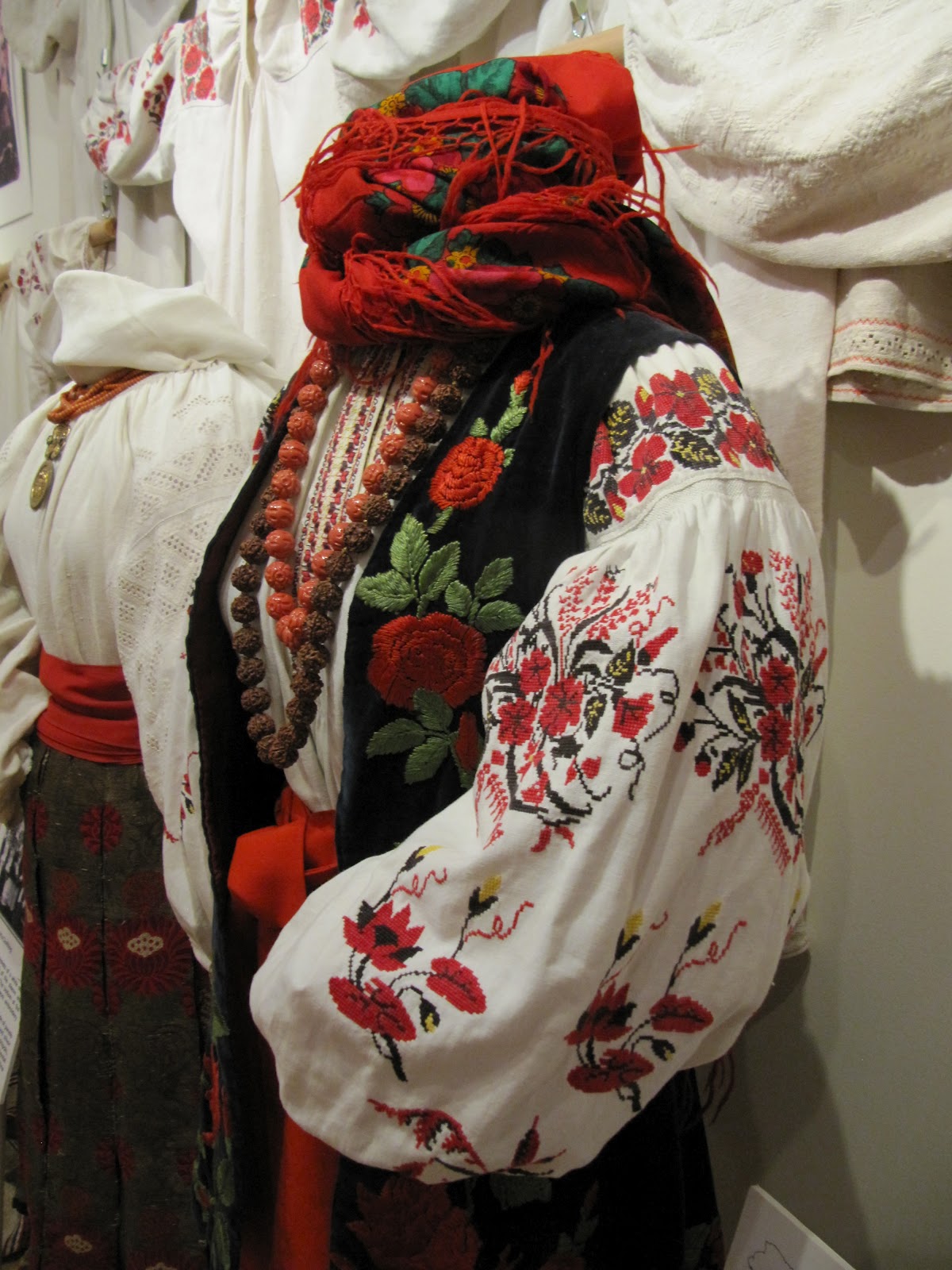
The embroidered "sorochky" exhibit opened Fri, Jun 9th, 2012, and will be on display for two months. There are 88 chemises from the Ukrainian National Museum Collection brilliantly exhibited on walls and a trunk, dramatically featured in a few frames and shown in full costume with bilingual ethnographic information. These were adorned with traditional beadwork: 'korali', 'gerdany', a Lemko 'kryza', a 'dukatch' pendant. And this the tip of the iceberg! There are about 158 'sorochky' from the XIX to XX centuries in their archives. See their video for an idea of what to expect.


East "sorochky' wall. Zakarpattia, Opillia & Volyn mannequins.
Row of "sorochky' on the east wall
The Dnipro Region, UNM Collection
On the way back from the Bead and Button show Monday we specially stopped in Chicago to view this folk art exhibit. Am I ever thankful we did! This was lucky for me, but I assure you this display is well worth the drive!!

Sorochky Exhibit at UNM, Chicago
Could not believe how prevalent the floral motif was in so many 'sorochky'... And how many interpretations and stylizations there were!! We left with a great respect for the culture, tradition, symbolism and awe at the genius of the creators of these works of art. 

I now have great material for future visual presentations. My next inspirational one is for this October's Creativ Festival. It's called "Nature Reinterpreted: Adornments and Decor".
From the East Wall of the Sorochky Exhibit

Sunday, February 27, 2011

Beaded "Pysanky" Eggs

Article by Maria Rypan, Spring 2011

Hot off the press! In time for Easter! My article about "Beaded "Pysanky Eggs" has just been published in the Canadian needle arts magazine, A Needle Pulling Thread, Spring 2011, pgs. 90-93.

"Pysanky", batik-style Easter eggs, are inherently Ukrainian. Purists shudder at the beaded "pysanka's" very existence. Some artists refer to the traditional motifs and designs for inspiration, but use beads to decorate eggs so the patterns become stylized.

Personally, I think there is a place for beaded eggs in this day and age. They may not have the talismanic powers of the real "pysanky", but they are beautiful and bring joy to the recipients.

This article talks about the different ways of applying beads on eggs in a "pysanka" style. Photos illustrate various methods and give an appreciation of how each and every bead is applied or beadwoven. Since no two eggs are the same, the article gives plenty of guideline for beading your own.
Several artists beaded "pysanky" illustrate the different application (gluing or beeswax) or beadweaving methods. Many photos and tips come from Vira Pavlova Witkovska's work. Vira is holding her butterfly ostrich egg while I show off her trident ("tryzub") egg at my last visit to the Vernisage in Lviv. Ivano Frankivsk teacher Maria Golovan kindly provided me with the step by step beadweaving photos and basket full of "beadwoven" pysanky. There's even a bead embroidered and stuffed one in the basket! There's no end to creativity!

Spring 2011, ISSN 1715-4650

Thank you to editor Carla Comanico for suggesting this article after she receiving my metric carton of beaded "pysanky" card. Get your issue for the maximum appreciation of this art form and other needle art projects.

Thursday, January 6, 2011

Christmas on the Julian Calendar

Christmas tree at home, MI
Best wishes of a Blessed and Peaceful Christmas and a Happy, Healthy and Creative New Year.
"Embroidered" satin ornaments by Maria

I was on my hands and knees late Monday a week ago photographing my 9 easels for the International One of a Kind Exhibit at JOGS in Tucson. Once I finished the easels, the Christmas tree in the corner of the room caught my eye. It was unique and magical...

It dawned on me the tree decorations were mostly homemade. My mother Martha (1927-2001) made plastic canvas snowflakes with each of her 4 granddaughters and I made all the satin sequins ornaments. She decorated this artificial tree with every one of my "embroidered" balls, mixed in solid colored ones and added silver garland. Now Nina, my step-mother, makes an annual trip up the stairs with the tree all-decorated and puts it into the icon corner. Afterwards she takes it downstairs.

The designs on the satin balls were inspired by Ukrainian embroidery patterns. I had an artistic license and used sequins to render the designs in traditional or contemporary color motifs. The outer circumference of the balls were fairly thin and allowed sequins on tiny head pins to be easily pushed in one at a time. The same was true for the box of satin thread bell and rondelle-shaped ornaments. It was best to steer clear of the thicker plastic near the hanger or bottom. The ornaments were created during my late high school/early college days. Each one was then tied on a ribbed curly ribbon. I'm amazed at the quality of that ribbon! And the satin balls have held up so well 40 years later! May the tradition continue for many more.

"Embroidered" with sequins & pins

Веселих Свят та Щасливого Нового Року!