pinterest pin it

Sunday, September 27, 2020

Lemko ‘kryvulka’ restoration

'Krvyulka' in the round

I was thrilled when Orysia Sopinka asked me if I could restore her mother’s ‘kryvulka’, a precious keepsake and a piece of her cultural identity.

It was a privilege to get up close, to study the thread paths of an incredible traditional ‘kryvulka’ beadwoven by young Eva Vakyriak (1920-2014). This was the ultimate adornment for the Lemkos, a ethnographic Ukrainian group and Eva made her own for festive occasions. 

Netted section ruffles when 'krvyulka' is straightened 

Eva would have beaded this as a teenager in her village of Chystohorb (Czystogarb), near Komancha (Komancza) in today’s Poland. In 1939 she left home forever to be an Osterbeiter, a foreign slave worker in Germany. 

Orysia brought this to me in January 2020. Right away I said this ‘kryvulka’ has a lot of stories it could tell. So, here is what I gleaned from my restoration experience.

A ‘kryvulka’, the local term in Komancha, is a ‘kryza’, a broad collar comprising of four distinct sections:


A - ‘polotnya’ - top choker-like band usually, a right angle weave, using two needles or one today in the R.A.W. stitch. 

B - vertical netting with rhomb motifs. This then attaches to the ‘polotnya’ choker.

C - horizontal ‘zigzags’, rows of 5 beads going through the center of the previous row  bead net to expand the width of the broad collar one colored row at a time.

D - ‘gombychky’, large accent beads used to trim along the lower collar edge.

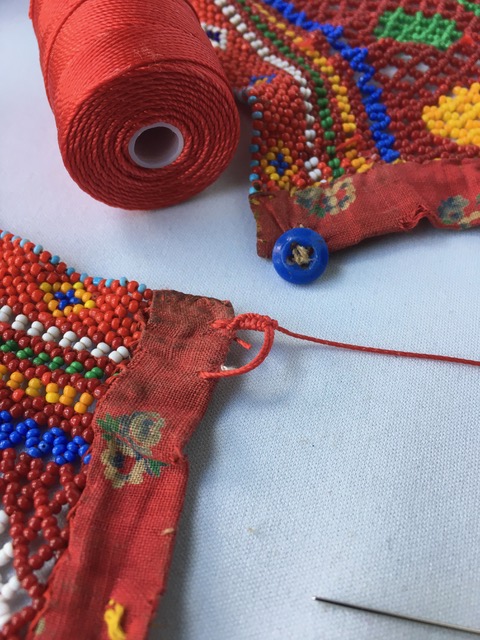
Eva ran out of large blue ‘gombychky’ beads and finished the trim with blue seed bead picots. She added a printed fabric to encase both ends so she could add a button and snap closure so her ‘kryvulka’ wears comfortably as a collar. Without this, the wide beaded net ends would fold over forward while wearing. 

Fabric encased ends

The best way of learning how something is constructed or beadwoven is to have to repair it! While it may seem sad, this is the best way to learn!

The entire ‘kryvulka’ was beaded with a red thick thread. Because of the tight tension, one wouldn’t notice missing beads or tears in places. Previous repairs would be with whatever beads colors were available. It was a challenge to repair in places because of the thickness of the thread/small size of the bead hole. Many fine needles broke in the process. I finally understood why there were knots and thread tails in places. It was a way to secure new thread, fill in beads and try to discreetly reinforce the addition.

I started repairing the netted motifs. One had to carefully add two beads above and below the mesh points in the vertical netting. Once the green rhomb net was repaired, I repaired a few more tears around.


By reconstructing this collar, I could clearly see how the ‘polotnya’ choker was attached to the top of the netted rhombs. It’s as if they were zipped together.


Though the horizontal zigzags are created with 5 beads as you expand the broad collar, when you repair tears, you simply insert two beads in between points as seen in the white row. 


Similarly for the blue zigzag row. In a previous repair red seed beads were inserted. Better red than have a tear! I wanted to change them back to a distinct blue row. 


The fabric closure needed cleaning so I gently ‘washed’ it with a cotton ball with detergent. When I saw the print lightening, I stopped and let it air dry.


The thread loop was badly frayed so I used a red cord to make a new loop. Thank goodness I remembered hand sewing basics my mother taught me!! 


I sewed on the blue button with red thread and reinforced the snaps on the fabric tab.

This was it for the reconstruction, but I wanted to figure out how to bead a ‘polotnya’  with extra 2-bead stack rows meant to be joined to the rhomb net.

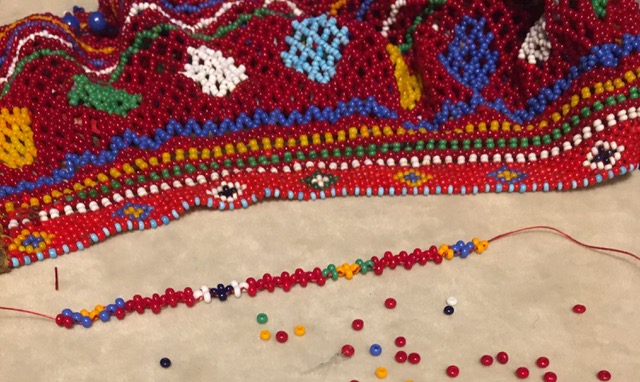
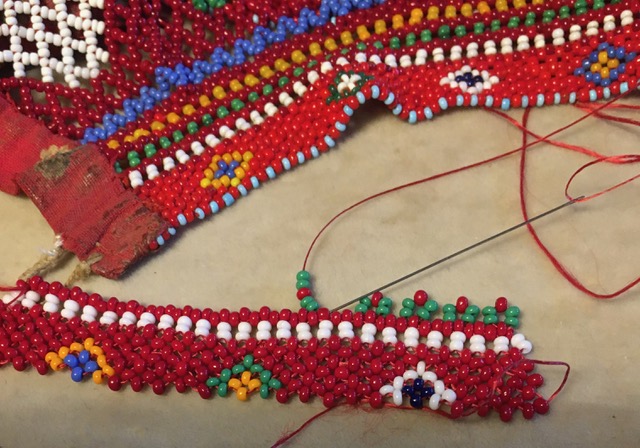
Instead or using the traditional two-needle method, I tried beading the center row of diamond motifs using Right Angle Weave (R.A.W.) with one needle. You can see my turn-around progress and motifs.


It took a while to figure out how to make 2-bead white stacks. Then how to add a single red bead to connect the stacks. Afterwards, I added a single red bead between the red bead edge. This created a solid red line.


Next was a row of 2-bead green stacks. These went faster using the same methodology, as above. 


Lastly, a row of 2-bead yellow stacks. Same start and solid red finish.


At this point, I was so happy “I got it!”. I photographed this from every angle and asked Orysia permission to use her ‘kryvulka’ with my R.A.W. reproduction for the cover of my personal Facebook page. I am a beader and I love red with intricate motifs. 

On June 15th I completed a massive update on Rypan Designs website on occasion on my 25th anniversary of teaching. 

July 1st, Canada Day 2020, I delivered the reconstructed ‘kryvulka’ to Orysia. What she showed me will be in my next blog. Here’s a sneak-peak.

Lemko ‘kryvulka’ and ‘leybychok’ (vest) beaded by young Eva Vakyriak.


Saturday, August 22, 2020

Sunflower Mask

The Toronto Bead Society’s Mask Challenge for an Aug 12, 2020 Zoom meeting and a request for a “fantasy piece” for an upcoming bead exhibit at the Ukrainian museum converged into this Sunflower Mask!


The Ukrainian Museum of Canada Ontario Branch and our neighbours at the Native Canadian Centre of Toronto are planning a co-produced exhibit titled The Spirit of Beads: Sharing our Stories.

What could be more Ukrainian than sunflowers?? They are Ukraine’s national flower and represent the warmth and power of the sun, which was worshiped by pre-Christian Slavs.

Inspiration photo and bracelet

My husband found this photo of a vibrant rich field of sunflowers. A netted bracelet with a beaded sunflower on top by Ulana Bobyk from Lviv inspired my freeform flowers.

I wanted my sunflowers against a bright blue sky. Jo-Ann gave me the perfect piece of ultra-suede for the background and cotton fabric to match at a time when stores with non-essentials were closed. I was determined the sky should be smooth all across the top. No seams! Just a pinch at the bottom and gentle pleats were acceptable.

Next, for beading my "fantasy" mask and one based on regional beadwork for the museum, I wanted to expand my color palette and use charlottes, a seed bead with a cut which reflects light and makes the bead embroidery sparkle. Naomi Smith, Black Tulip Beads, came to my rescue and Charles even delivered the beads, and more beads, in two lots!


For the sunflower seed center, I started with a circle of six brown beads. I kept changing the color and type of bead for every rotation. Sometimes, I used one, or two beads in between those of the previous row. The seedy center grew and then I’d start stringing an assortment of yellow beads for each petal.

2 of 3 flowers pinned in place

I found it best to start with a yellow-orange or two beads first; then vary the finishes to a picot turn around. On my way down, I’d improvise with the mosaic stitch and color of beads. Then I'd anchor the petal and move on to string another combo for the next petal.

Testing the placement

There was a lot of trial and error. With safety pins securing my beaded sunflowers, I tried to see how many more I needed to bead, where to position them. Coincidentally, my calendar featured a sunflower mural for August, so it’s like this was meant to be! The extra fingers belong to my husband, the photographer.

Starting a leaf

I netted the leaves in many shades of green. I sketched the first row and kept playing with color placement and shaping the leaves into more realistic shapes. I repeated it a few times, but each leaf is a bit different as it is in nature.

Shading and shaping

The final layout

Once I had my components, came the “positioning the sunflowers” fittings. Here we see them stitched onto the flat ultra-suede. I trimmed away the corner to allow for shaping on my face and stitched the outline of the dart for the bottom of my mask. Then I positioned my leaves and stitched them down. 

Preparing the layers

I cut the cotton fabric a bit larger than the ultra-suede. I started off with the folded down edge along the top and lined it up with the straight mask edge. I back-stitched a dart in both fabrics and used a quilting technique to make the seam as flat as possible. 

Stitching it together 

The top was finger-pressed one way, the lining dart was pressed the other way. There was no bulk along the bottom edge when I tucked under the excess lining fabric. The sides were pleated last.

Detail of  3-bead edge

I decided to used a 3-bead finish to join the front and lining together in a single stitch. Once I figured out how to do the stitch and sequence of colors, I bead-finished the top edge. I chose to use lively warm Hutsul-colors of yellow-orange, orange and green. Once the top was stitched, I did the bottom and sides. I’m pleased the diagonal pattern worked out perfectly all around. 

Twisted cord ties

For ties I used DMC Mouline floss in matching traditional colors. There were several attempts to twist the thread like I used to with my mother. The twisted cord with three colors was quite thick when it was folded in half and twisted further upon itself. I felt it appropriate for tying on my mask since it’s the way finish of embroidered ‘sorochky’ (chemises) or beaded necklace for wearing.

Finished and ready for Zoom meeting

The Toronto Bead Society Mask Challenge Reveal meeting was right when we were on vacation in Kingston, ON. I finished each chord end with a tassel in the motel. Thank goodness I was able to participate in the Zoom meeting through my iPhone.

TBS Zoom meeting


This is my favorite kind on meeting, because we get hear everyone’s stories. The ideas behind their design and their creative process.

It was amazing to see the great variety of masks.

Friday, July 10, 2020

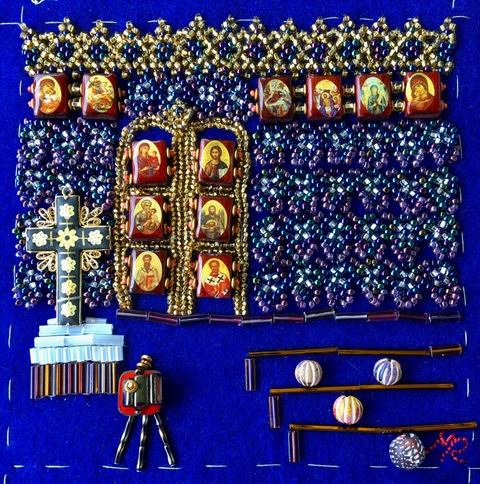
Beaded Square Project: "Divine Liturgy Online"


As I was scrolling through my news feed on Facebook, a call for submissions popped up from the Museum of Beadwork in Portland, Maine. First time I'm hearing about this one... I've visited the Bead Museum in Washington, DC back in 1990s, then the one in Glendale, AZ in 2000. Even donated a set of my Beadwork Lesson books to both libraries. Both of these museums are no more, but someone else is trying again! 

The Museum of Beadwork is a new collaborative effort with Caravan Beads who have been around since 1991. The Museum "is mounting a new community project which grows out of a desire to commune on a joint project while safely sheltering; marking this very particular time we are going through together, apart. The end result, which will be exhibited at the Museum of Beadwork, will be a bead based ‘quilt’ visualizing the individual and communal experience of this distinct moment in history." 

They asked for a 6" (25x25cm.) square of beadwork, no matter what style, technique or experience covering more than 50% of the surface. It should be mounted on a strong supporting material to facilitate hanging in the 'quilt' installation. This is where a spare shelf from an Ikea CD/video storage unit came in handy. 

I must support the Museum by participating in the new Beaded Square Project! What can I contribute?? How have I been affected? As everything was totally shut down, so were the churches, places of worship. It was a huge shock, but somehow through online Liturgies, Lenten and Easter services, we persevered.

Finished piece in front of my parish, St. Demetrius Ukrainian Catholic Church, Toronto

Once I knew that I was going to create a square about the closure of the churches it was time to find inspiration in my collection of beads and beaded objects. 

The wooden bracelet tiles would help to create the interior of a Byzantine church. They would serve as my icons, windows to heaven. They were perfect for creating an iconostasis, the screen which separates the sanctuary from the main part of the church. Closed Royal Doors with a few icons each are the focal point. Services begin when they open, so the camera off to the side is ready to video record the service. Bugles could serves as pews and a few people distanced apart could be added for when the churches opened slowly for a small congregation spaced far apart. 

Icon bracelet will serve a higher purpose

My previous sewing experience came in real handy! I used a royal-coloured felt square for my base. Fortunately, I had a large double-side backing paper handy. Once it was cut to 6" x6" size, I adhered it to the back of my felt leaving wider margins for the final finish later. I basted around the adhered backing to be able to know my boundaries when working on the front of the square.

Basting guidelines

Couching beadwoven netting to the felt

Bead embroidery is daunting! I rummaged through my bead woven samples to see if I had something to fill in the background of my iconostasis between the icons. I was thrilled to find a 8/ gold and navy iris 'Netting with an X' sample which would be perfect to couch down along the top of my square. This set the heavenly tone. 

Another great find was my 'Picot with an X' necklace. If I cut it apart in 3-swag segments it could fill in the left of the Royal Doors, while 6-swag pieces were perfect for the right. This involved adding thread to properly secure the edges of each segment so I could move them freeing without pulling apart.

Cutting old beadwoven necklace into useable lengths

Working on the layout

For the frame of the Royal Doors, I used the Ndebele stitch to bead weave two pairs of herringbone stitches in a length to the top of the icons. Here I split and beaded on one pair at the time long enough to go down the other side of door panel. Repeated this for the other door panel.

To combine the wooden icon tiles into cohesive units, I added an 'O' bead at each hole opening. I use a large silver-lined gold crow bead between the four and two icons. I used a little coral 10/ seed bead as a turn around at the very end of the icon clusters. I used the same end trim for individual icons set into the royal doors on the Ndebele gold door frame was stitched down.

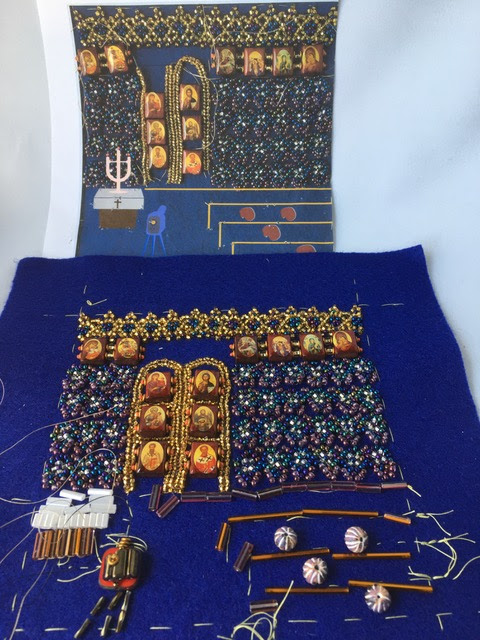
Work in progress with my layout image to guide me

For a better idea of how the square will look, we cut out a 6' window in a sheet of paper. As I overlaid it, I took several photos of my beadwork as I was working. My husband downloaded one and drew out my key elements from my sketch in Photoshop. Since this was a more realistic scene. I wanted to have perspective to draw the viewer's eye in. 

This print was handy for making tailor tacks to mark the positioning of the pews, side tetrapod table, camera. This too was from sewing world when I used to tailor tack marking on patterns for making darts in my clothes.

Beadweaving a cross for the design

I needed to bead weave additional picot swags to fill the spot between the rows of icons and above the Royal doors.

It took three tries to bead a miniature Byzantine cross. I used Right Angle Weave, but found the challenge was how to give it definition. Weaving in microscopic navy iris cylindrical beads at the corners of each cross arm did the trick. I then attached my cross to the top two beads of the door frame in front of the patterned background.

To create the tetrapod, a small table off to the side, I found some chicklet pressed glass beads from retired bracelet and twig necklace kits. I ladder stitched 10mm two-tone silver lined chicklets for the base. Then I stitched together 5mm pearlized ivory chicklets for the folded over cloth. For the tablecloth, I horizontally stitched down longer chicklets going back to pearlized bugles to try to suggest depth. 

I added a crucifix I used to wear as a teenager. In my view, having it as part of my beaded square for the Museum installation, it's gone to a good home.

Signed and ready to be attached to a board

I embroidered my initials in the lower right corner to sign my little beaded work of art. After double, triple checking, it was time to wrap the beaded felt around the sawed down board. 

Test fit

We added double-sided tape along the top edges to anchor the embroidery. Once we turned it around, we added double-sided tape along the back edges to hold in place while I mitered the corners and trim away excess fabric. Again, I had the perfect royal blue thread for stitching down the corners.

Securing to the board

Once I stitched it all together, I went to show my completed square to Rt. Rev John Tataryn, pastor of St. Demetrius the Great Martyr Ukraine Catholic Church. Father marveled at all those tiny beads and the time and eyes it took to created the square. He suggested to call it "Divine Liturgy Online".

Finished and ready for shipping

Here is my statement that I included with my Beaded Square:
When the pandemic hit, the closure of churches was devastating. Luckily, many churches were able to adapt to streaming religious services, so we, the parishioners, could keep our faith alive in our own Domestic Church.

Be creative and stay safe,
Maria