pinterest pin it

Saturday, March 9, 2013

ABC's of Creativity - E is Embroidery

Embroidery is the art or process of forming decorative designs with hand or machine needlework. There is no end to the types of stitches and their possibilities, singularly or in combination.

Mother and daughter in Hutsul dress. The 'sorochky' and 'keptarl' vest are embroidered. The little girl's 'sorochka'  has all the traditional elements, but in miniature. I just love the beaded 'sylianka' 'gerdan' around her neck.
Photographed at the Yaremche Festival, 2006
Many nations have there own unique styles which serves to identify where the people are from. Folk costumes can be very specific to a particular village, a region, and finally a nation. This was true in the late XVIII centuries to mid XX centuries in Ukraine and its neighbours.

Hutsul region. Love how the 'sylainka' beadwork goes with the embroidery. The 'serdak' jacket is also embroidered with wool. Yaremche Festival, 2006  
A few embroidered 'sorochky' on display at the 60th anniversary exhibit of Ukrainian National Museum, 2012


Nastasiya Marusyk wears a Bukovynian bead embroidered 'sorochka' from Zastawniw and a bugle beaded 'obhortka' wrap skirt. Olya's 'sorochka' is also beaded while her 'obhortka is woven. Nastia embroidered this  original 'rushnyk' ritual cloth.
Ukrainian National Museum, Chicago, 2012

Embroidery can be a work of art in itself. An expression of creativity.
Close-up detail of Nastia's own 'rushnyk' pictured above, 2012
Detail of another of Nastasiya's unique 'rushnyky', 2012
Traditional embroidery with a one of a kind pictorial story below. Seems like love was in the air when this 'sorochka' sleeve was embroidered.
Detail of a 'sorochka' from the Hnatiuk Collection.  Note the "carved out" design created with a clever use of the needle and thread. Ukrainian Museum and Archives, OH, 2011  
Borschiw 'sorochka', Ternopil Region, from the Hnatiuk Collection.
Ukrainian Museum and Archives, OH, 2011
Detail of a 'sorochka' from the Pokuttya Region.
Collection of O. Turyansky, Ivano Frankivsk, 2004
Bedcover  sewn together using Bukovynian 'sorochky' from the end of the XIX century by Osypa Hryhorovych of Majeriw, Ukraine. Ukrainian Museum and Library, CT, 2012
Bukovynian 'sorochka' sleeve panel from the bedcover. Note the metalic beads and sequins embellishment. Ukrainian Museum  and Library, CT, 2012
Bukovynina 'sorochka' sleeve panel from the bedcover. Strings of seed beads color the flowers. Ukrainian Museum  and Library, CT, 2012
Dnipro Region 'sorochka' and embroidered 'korsetka'.
Ukrainian National Museum, IL, 2012
Detail of 'sorochka' embroidered with cross-stitched flowers.
Ukrainian National Museum, IL, 2012
Detail of a Bukovynian 'sorochka', mid XIX century.
Ukrainian National Museum, IL, 2012
Opillya Region. Seed bead embroidered corsette with sequins on the tabs.
Hnatiuk Collection, Ukrainian Museum and Archives, OH, 2011
Opillya. Same region, but the individual's personality is revealed with her own seed bead embroidered flowers.
Ukrainian Museum and Archive, OH, 2011
 The loom size determined the width of each panel. The cut and construction is very basic. The embellishment is gorgeous. Note decorative stitching to camouflage the seams.

'Sorochka' framed as art.  This 'sorochka' is embellished with beads.
Ukrainian National Museum, IL, 2012
Sleeve detail of the 'sorochka'. Note the interesting pattern created by repeating three motifs . Also the raised white motifs are created by unique 'curly' stitches. Seed beads embellish the black outlined motifs.
Ukrainian National Museum, IL, 2012


Detail of my 'sorochka' from the Bukovynian Region. Note the bead embellishment in the flowers.
Maria Rypan Collection, 2006
It does not have to be an even count fabric, though this is handy for cross-stitch and geometric patterns.  Sheepskin has been used to embroider on in the Carpathian Mountains.

Deerskin was used by the First Nations. The cut and decorative design of dresses or jackets told from which nation the wearer was from. Pouches, bandolier bags and moccasins were also embroidered in regional styles.

Santee Dakota Northern Plains men's jacket, about 1870's.  It has glass and metallic beads embroidered on tanned hide. Museum of Civilization, QC, 2010
Moccasin display. Bata Shoe Museum, Toronto, 2012
Pair of Southeastern beaded moccasins. Bata Shoe Museum, 2012
Woodland beaded moccasins display. Bata Shoe Museum, 2012
Pair of Woodland beaded moccasins. Bata Shoe Museum, 2012
In bead embroidery, a single or combination of "anything with a hole in it"can be picked up on a needle and stringing material. The beads are secured to fabric or a new embroidery medium courtesy of a few stitches. Some people embroider accessories, i.e. bags, clutch purses, headdress, even shoes.

Beaded butterfly decorating an embellished shoe by Roger Vivier, France.
Special exhibit at the Bata Shoe Museum, 2012


Pearls seed bead embroidered shoes by Roger Vivier, France.
Special exhibit at the Bata Shoe Museum, 2012
Embroidered fabric shoes by Roger Vivier, France.
Special exhibit at the Bata Shoe Museum, 2012
Roaring Twenties hat embellished with fabric flowers and creatively embroidered leaves coordinate nicely with the shoes with cut-out pattern on the tips.
Bata Shoe Museum, 2012
Embroidery can be used to embellish functional objects around the home. There is no end to the possibilities here. It could be a table runner, tablecloth, decorative pillow, curtains or wall hangings.

In retrospect, you've just seen fine examples of decorative embroidery created in two very different corners of the world. There's plenty here to inspire your creativity.

And I haven't even touched on the new forms of bead embroidery around cabochons! Freeform embroidery is fun. There are a lot of gorgeous neckpieces and bracelets being created today.

We'll just have to continue this topic another time... Meanwhile, do give embroidering a try. It can be very  Zen-like calming change of pace!


Thursday, February 28, 2013

ABC's of Creativity - D is Design Decisions

One definition of to design is to plan and fashion artistically or skillfully (from dictionary.com). The decisions that you make as part of the design process are as varied as the sources that drive them. 

Many brides look for matching jewelry for the bridesmaids. Sometimes you maybe lucky enough to find a kit for the perfect style in the perfect color. Rebecca, a bride from southwest Ontario, was that lucky with this 1-drape Gothic necklace. The color was a perfect match to the aqua dresses the bridesmaids were wearing.

Beadwoven by Rebecca Rynsoever
Of course sometimes a friend will ask to have something made in a color you may not normally work with. Here my friend Susan want a pink necklace for a young family member's first communion. Using the same design as Rebecca did for her bridesmaids I used pink Swarovski crystals and seed beads.
Beadwoven by Jo-Ann Woolverton
Then there are times when someone asks what if you used something different. My friend Anna thought that the 1-drape Gothic necklace would look great done with Swarovski crystal pearls. She was right, it a elegant necklace that would be perfect for a bride.

Beadwoven by Jo-Ann Woolverton
 
So that is one style of necklace with three different looks created by the decision to use different materials.

The Twig Chip Cascade necklace like so many designs can be changed by make a unique design decision for your personal necklace.
Here is the original, the multi-colored chips look great with basic black and a red accent. Beadwoven by Patricia A. Huff


Change the chips to orange cat's eye chips and a more monochrom color palette looks great. Beadwoven by Jo-Ann Woolverton


Green Millifori chips with a hint of orange needs an accent of orange in the netted band. Beadwoven by Jo-Ann Woolverton


The blue millifore chips look best with white cubes and accents of dark blue. Beadwoven by Jo-Ann Woolverton

Here our bride Rebecca has used pink crystals on the twigs to go with the vibrant flowers in her bouquet. To add texture to the netted band she change the chicklets to an alternating pattern of bugles and clear crystals.

Beadwoven by Rebecca Rynsoever

Last year Maria was contacted by a bride in Winnipeg asking about have a necklace designed to wear on her wedding day. She wanted something that would look great with her gown but still represent her Ukranian heritage. Taking the Twig Chip Cascade necklace Maria changed the chips to pearls and used silver lined beads as an accent.

Beadwoven by Jo-Ann Woolverton
Here is a look a the trials made during the original design process of painted strips edition of Textured Net and Chicklet bracelet.

On the left black picots, in the middle strip beads used for picot with a black accent above the picot and on the right same as the middle with the addition of a black accent at the neck edge.

Here on the left we have added a silver lined clear accent above the picot and on the right we changed it to a lime green accent.
On the left picot on the bottom, in the middle fire polished crystals on the bottom and on the right a larger fire polished crystal

Final version with a black lantern shaped bead on the bottom

On the left painted strip beads on upper and lower edge as well as either side of chicket, in the middle lime green on upper and lower edge and on the right black on the upper and lower edge

Here are the finished final designs from the painted strips collection.


Here are a series of necklaces that are variations of the Suspensed Swags. Each is unique because the beader asked 'what if' as they worked the design.

What if --- you wanted to have a unique closure.

Suspensed Swags with Swarovski embellished chain and handcrafted closure hook, beadwoven by Kathy Foernzler
What if ---- you added a drop bead to the finish the connecting pillars.

Cascading Swags with drops and handmade closure, beadwoven by Nance Carter
What if ---- the swags were longer and overlapping.

Reversible suspended swags, beadwoven by Jo-Ann Woolverton

What if ---- you added drops to the middle of some of the swags.

Suspended swags with bronze drops, beadwoven by Tatiana Martschenko
Let what ifs, requests and playing with colors continue to help you on the creative path to making amazing and unique beadwork.

Wednesday, February 13, 2013

ABC's of Creativity - C is Color

Visual presentation by Maria Rypan, 2012;
"Beader's Palette" by Jan Huling


"Beader's Paint Box" presentation for Creativ Festival Spring 2013
INDO Bracelet, Lariat & Earrings, Rypan Designs 

How do you get your beadwork to pop? Maria's presentations share a little bit of colour theory with lots of examples to show how to place bead colours, finishes and metallics against each other. The visuals make it possible to examine many variation and then apply what was learned in your beading. 

Color is a phenomenon of light or a visual perception that enable one to differentiate otherwise identical objects. It is described in terms of hue, lightness and saturation for objects; hue, brightness and saturation for light sources. Hue can be contrasted with black or white. (Miriam-Webster Dictionairy)

The relationships are best understood with color wheeels, a concept invented by Sir Isaac Newton in 1666.  These wheels from Color Matters show the basic concept.

Primary Colors. You can't stir beads to create the secondary or tertiary colors. But you can choose to place them according to the color wheel. These beads all have the same saturation. Black is not a hue. 
INDO Lariats have novel Indonesian lampwork beads, Rypan Designs 
Complementary. These beaded boxes use the very same hues, but vary in their color placement within the same design.
"Anemone Box Series" beaded by Jo-Ann Woolverton; inspired by Julia Pretl
Complementary. Using a bit of the opposite color on the wheel gives your beadwork zing.
"Wisteria" Textured Net, Rypan Designs

Analogous. Use colors next to each other on the wheel. These warm colors seem to advance.
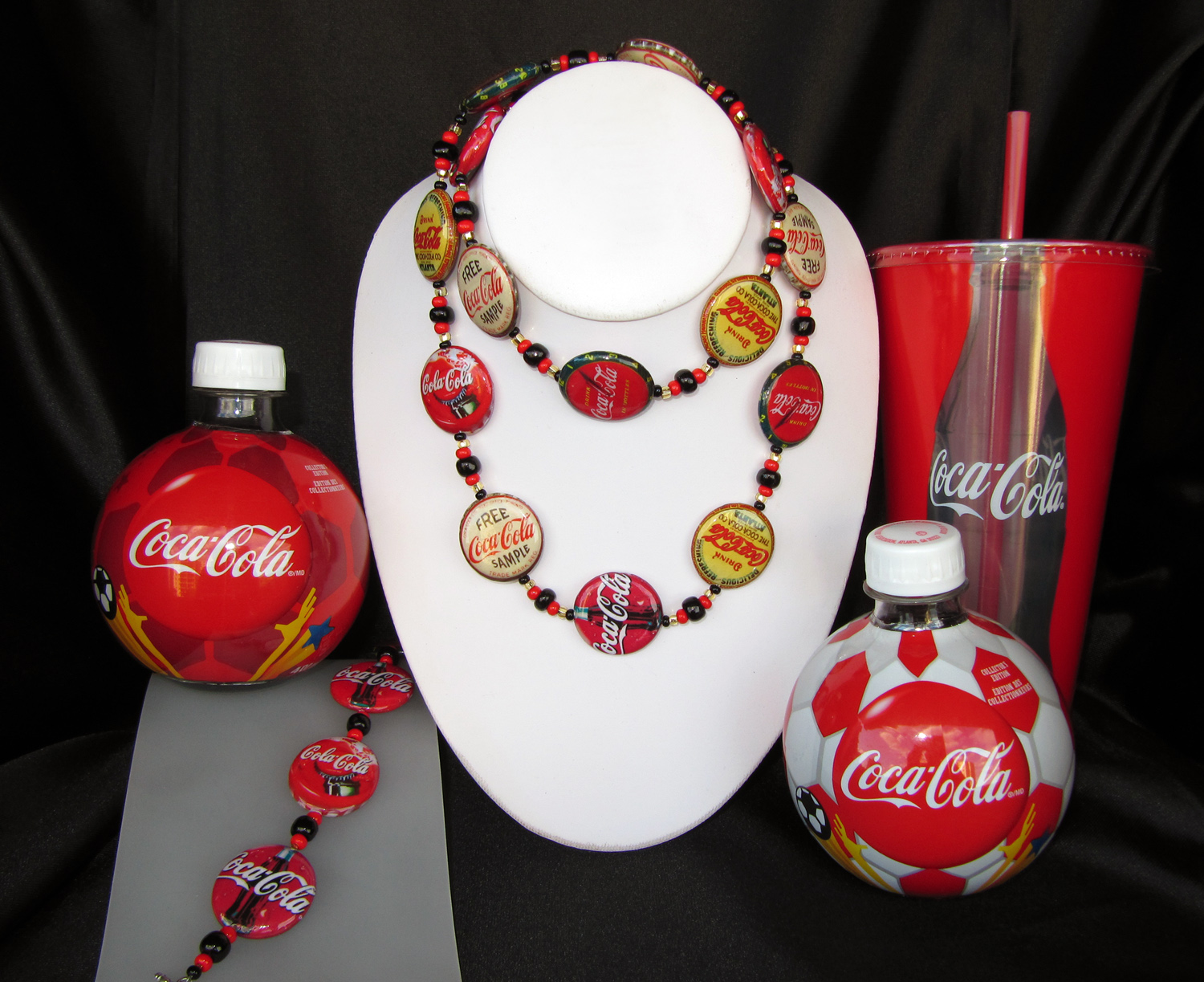
"Coca Cola Bottle Caps" necklace and bracelet by Maria for friend Dolores
Monochromatic. Try tints and shades of the one color to make it interesting. These cool colors seem to recede.
Dangle Earrings using Swarovski ELEMENTS®, Rypan Designs 
This TBS Bag of Bead Challenge was full of opaque, transparent and  silver-lined TEAL seed beads. It also included the pressed glass, buttons and sequins.
Two pairs of complimentary beads were strategically placed to create the netted pattern. Note the playful color effects and turnaround beads in the strung fringe.

"Sedona Kilim",  Maria Rypan, 2000
Rainbow® Color Selector is a 5" wide tool which also comes in a Tonal Color version.
It's available from Fire Mountain Gems.
This ultimate color wheel was designed as a fundraiser by Ewelina Rzad. 50 beaders from Poland participated. Soutache and seed bead wrapped cabochons are tastefully layered into a collar. Each cabochon is a mini work of art. Light tinted red and purple hues create the 'V' which turns to cool colors on the right and morphs into warm colors on the left. 
"Tęczak - The Rainbow". CLICK to see how cabs were wrapped in soutache by the bead artists
Margie Deeb's bible for beaders
This is the only book of its kind written specifically for bead artists, The Beader's Guide to Color teaches beaders of all levels everything they need to know about color to create unique and vibrant beadwork designs. Author and artist Margie Deeb discusses in depth the psychological and symbolic associations of all the colors of the spectrum, and the ways in which color can be used to create and accentuate pattern, rhythm, and movement. Twenty-one color schemes are described and illustrated in detail with accompanying projects. 
Playing with color is fun!